
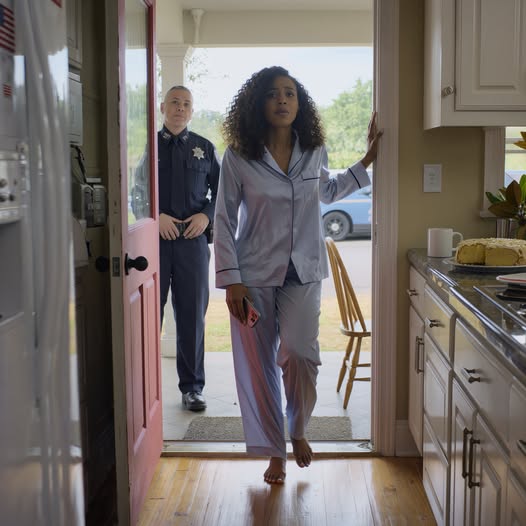
During Mother’s Day dinner, my sister proudly shared that her third baby was on the way. My mom clapped her hands. “This is everything I wanted.” Then my dad turned to me.
“You’ll be helping with the kids.”
I froze. “Excuse me?”
My sister rolled her eyes. “You’re not doing anything with your life anyway. This will give you purpose.”
I smiled, pushed my chair back, and left the house. The next morning, my phone buzzed with an unknown number.
“Good morning, ma’am. This is the police department…”
My name is Martha Pierre. I am thirty-seven years old, and the night that broke my family open started with a dinner I almost did not attend.
It was the second Sunday of May, 2024. The date was May 12, and the sun had already started to set behind the row of magnolia trees that lined the street of my childhood home in Baton Rouge, Louisiana. I remember pulling into the driveway and sitting in my car for a full three minutes before turning the engine off.
Something in my gut told me to drive away. Something quiet but sharp, like a whisper wrapped in glass.
But I did not listen. I never listened to that voice. Not back then.
I had spent the morning at my own house, a modest two-bedroom place on Roofon, about twenty minutes from where I grew up. I had bought it four years ago with money I saved working as a licensed medical coder at Crescent Health Systems. It was not glamorous work. It was not the kind of career that made family members clap at reunions. But it paid well. It gave me stability. It gave me peace.
And peace was something I had learned to protect like oxygen.
I had baked a lemon pound cake that morning for the dinner, the same recipe my grandmother, Odessa Pierre, used to make every Easter. I wrapped it in foil, placed it in a box, and drove over with every intention of staying no longer than two hours.
That was my rule. Two hours at family dinners: long enough to be present, short enough to survive.
When I walked in, the house smelled like garlic butter and roasted chicken thighs. My mother, Francine Pierre, was standing in the kitchen wearing a lavender blouse with pearl buttons, her hair freshly pressed, lips painted in that shade of wine she always wore when she wanted to look regal. She was sixty-three years old and carried herself like a woman who believed she had done everything right.
That was the thing about my mother. She never questioned herself. Not once. Not about anything.
My father, Renard Pierre, was in the living room watching a baseball game with the volume too loud. He was sixty-five, retired from his position as a warehouse supervisor at a logistics company in Gonzalez. He had a beer in one hand and a toothpick between his teeth. He looked up when I walked in, gave me a nod, and went back to the screen.
That nod was about as warm as our relationship had been in the last decade.
And then there was my sister, Colette Pierre Landry. She was sitting on the couch with her legs folded beneath her, scrolling through her phone, her two children running in circles around the coffee table. Colette was thirty-three years old, four years younger than me, and in the eyes of my parents, she was the sun around which every planet in this family revolved.
Her eldest, a boy named Enzo, was five. Her youngest, a girl named Sole, was two. They were loud and messy and full of energy. And within seconds of me walking in, Enzo had already knocked over a glass of water on the side table. Nobody moved to clean it up. Colette barely looked up from her phone.
Her husband, Damen Landry, was not there. He was almost never there. Damian worked as a long-haul truck driver and spent most of his time on the road between Texas and Florida. When he was home, he was quiet and detached, like a man who had accepted that his role in the family was to write checks and disappear.
I set the pound cake on the counter and kissed my mother on the cheek. She smiled, but it was the kind of smile that had a schedule behind it. She was already arranging plates, already choreographing how the evening would go.
My mother loved control the way some people loved music. She could not live without it.
Dinner started at six.
We sat around the same oak table where I had eaten every meal as a child. The same scratched surface. The same wobbly leg on the left side that my father had never fixed. My mother had made roasted chicken, rice and gravy, collard greens, and cornbread. She had also made a sweet potato pie, which meant my lemon pound cake would be pushed to the side.
It always was.
For the first thirty minutes, things were normal. My mother talked about the women in her church group. My father chewed loudly. Enzo threw a piece of cornbread at Sole, who started crying, and Colette told her to hush without looking away from her own plate.
I ate quietly, counting down the minutes in my head.
One hour and twenty-six minutes left.
Then Colette put her fork down. She looked at my mother, then at my father, and she smiled in a way that made my stomach tighten. It was that smile, the one she wore when she had news, the one she wore when she knew the spotlight was about to land on her and stay.
She placed both hands flat on the table and said, “I have an announcement.”
My mother immediately leaned forward, her eyes wide, her lips parting like she had been waiting for this exact moment all evening. My father muted the game on the television behind us. Colette took a breath.
“Baby number three is on the way.”
The room erupted.
My mother clapped her hands together so hard the silverware rattled. She stood up, walked around the table, and wrapped Colette in a hug that lasted longer than any hug she had ever given me. She was crying. Actual tears.
“This is everything I wanted,” she whispered. “This is everything I have been praying for.”
My father leaned back in his chair and smiled. Not at me. Not at the table. At Colette. Always at Colette.
I sat there with my fork still in my hand, watching the celebration unfold like a parade I had not been invited to.
I was not angry. Not yet. I was just still.
I had learned to be still in moments like this, to let the wave of attention roll past me without trying to swim against it. Colette sat back down and started talking about due dates and nursery colors and how she hoped it would be another girl. My mother was already planning a baby shower. My father was already calculating how to convert the guest room into a nursery when Colette visited.
And then it happened.
My father turned to me, not with warmth, not with curiosity, but with instruction, like he was delegating a task at his old warehouse.
“You will be helping with the kids,” he said.
I blinked. “Excuse me?”
He did not repeat himself. He just stared at me like the matter had already been settled.
My mother jumped in. “Martha, you have the most flexible schedule out of all of us. It only makes sense. Colette is going to need help, especially with three little ones and Damian on the road.”
I opened my mouth to respond, but Colette beat me to it. She looked at me with an expression I had seen a thousand times before, that mixture of pity and superiority she had perfected since childhood.
“You are not doing anything with your life anyway,” she said. “This will give you purpose.”
The table went silent.
Lees verder door op de knop (Lees verder »») hieronder te klikken!