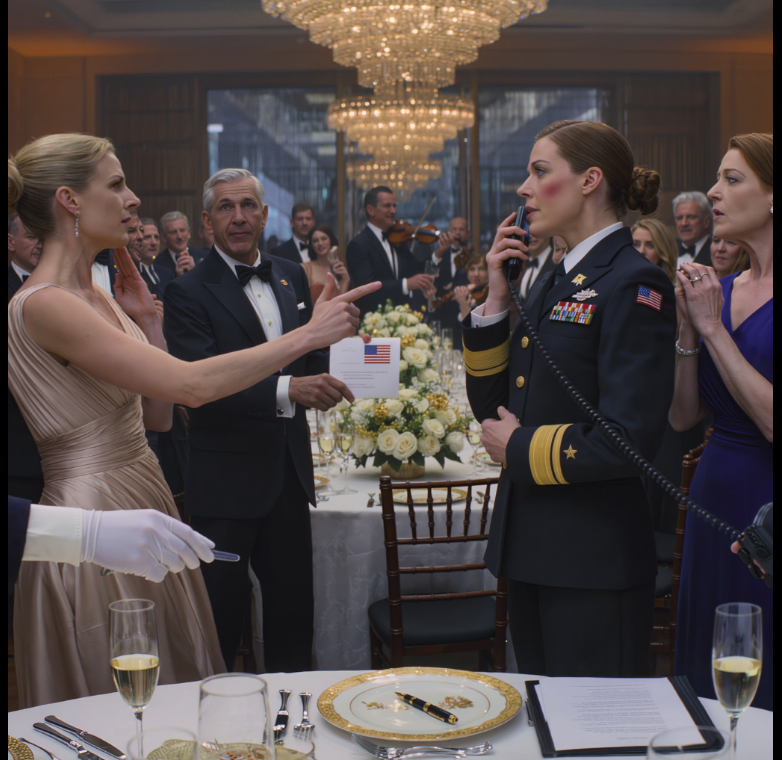

Mijn zus had geld nodig. Tijdens het familiediner zeiden ze dat het “mijn taak” was om haar te helpen. Mijn moeder zei: “Je bent haar alles verschuldigd.” Mijn vader was het daarmee eens. Ze hadden mijn naam al gebruikt voor een lening van $450.000.
Ik heb niet gediscussieerd… ik heb gewoon één telefoontje gepleegd. Eerst klonk het geluid, een scherpe knal die dwars door een balzaal vol beleefde gesprekken en geforceerd gelach heen sneed. Daarna de stilte.
Vijftig mensen hielden abrupt hun adem in, alsof iemand de tijd in de kamer had stilgezet. Mijn hoofd draaide door de klap iets naar rechts. Ik struikelde niet. Ik deed geen stap achteruit.
Ik voelde het gewoon, de hitte die zich over mijn linkerwang verspreidde, precies en direct als een waarschuwingssignaal. Ik hield mijn houding rechtop. Mijn naam is Riley Sullivan, majoor in het Amerikaanse leger, logistiek en cyberinlichtingen, 32 jaar oud, getraind om chaos te verwerken voordat ik erop reageer. En recht voor me, in een designerjurk die ze zich zonder fraude niet kon veroorloven, stond mijn jongere zus, Paige.
Haar hand was nog half omhoog. Haar gezicht vertoonde geen schok. Ze was zelfs niet verlegen. Ze was boos.
Niet het soort woede dat voortkomt uit gekwetst zijn. Maar het soort woede dat ontstaat wanneer je de controle verliest voor een publiek. Om ons heen zat onze uitgebreide familie als aan de grond genageld. Tantes, ooms, neven en nichten, vijftig mensen die jarenlang hadden toegekeken hoe ik stilletjes op de achtergrond bleef bestaan terwijl Paige haar leven opvoerde alsof het een realityshow was.
Niemand zei iets. Niemand bewoog. Ze wachtten tot ik iets dramatisch zou doen. Huilen, schreeuwen, terugslaan.
Ik heb niets van dat alles gedaan. Ik keek eerst naar haar hand, las de tekst op haar handpalm, en toen keek ik naar haar gezicht. Vervolgens liet ik mijn blik zakken naar het witte tafelkleed tussen ons in, waar een pen en een document lagen, alsof het een mislukte scène was. Daarna greep ik in de binnenzak van mijn uniform.
Niet snel, niet langzaam, gewoon beheerst. Als je ooit voor een zaal vol mensen bent gezet, nota bene familie, en er van je verwacht werd dat je stil bleef om iemands leugen in stand te houden, dan ken je de valkuil. Als je weigert, word jij het probleem. Als je gehoorzaamt, blijft de leugen bestaan. Dit verhaal gaat niet over wraak. Het gaat over wat er gebeurt als je eindelijk stopt met het spelen van de rol die je is opgedragen.
Zes maanden eerder was ik in het buitenland gestationeerd en hield ik me bezig met routineonderhoud van beveiligingssystemen. In mijn vakgebied wacht je niet tot problemen zich voordoen. Je zoekt ernaar voordat ze de kans krijgen om problemen te worden. Elke zes maanden voer ik een volledige achtergrondcheck op mezelf uit.
Financials, credit activity, digital footprint, everything that could compromise my clearance or make me a target. It’s not optional. It’s protocol. I logged into the system at 02:27 local time. Standard review.
Expected duration under an hour. At 02:29, I found the anomaly. A commercial bridge loan, $450,000. My name listed as the primary guarantor.
The asset tied to the loan, the Sullivan Family Agricultural Trust, got my full attention. The farmland wasn’t just property. It was generational property, passed down from my grandfather. Legally structured in a shared trust between me, my parents, Arthur and Helen, and Paige.
Any financial action tied to that trust required documented consent from all primary parties. I hadn’t signed anything. I pulled the full loan file.
Originating bank: regional commercial lender out of Massachusetts. Loan purpose: short-term capital for real estate development staging operations.
Borrower: Paige Sullivan LLC. Guarantor: Riley Sullivan. That last line was clean. Too clean. No hesitation marks.
No irregular spacing. No obvious signs of tampering. Which meant whoever did this didn’t fake it. They replicated it.
I didn’t call home. I didn’t send a text. I kept digging. First step, access logs.
Every digital signature tied to a commercial loan carries metadata. Timestamp, IP address, device, signature. It’s not visible on the surface, but it’s there.
The signature timestamp was 11:42 a.m. Eastern time, three months prior. The IP address traced back to a residential network in Boston, my parents’ house. I leaned back in my chair and ran it again.
Same result. Then I checked the notary. The document had been notarized by a licensed attorney in Suffolk County. The name matched a local lawyer my father used to mention during golf weekends.
I remembered the name because he once joked the guy could make paperwork disappear if you asked nicely. I pulled the notary record. Legitimate registration, which meant either the notary was compromised or willingly involved.
I moved to financial tracing. The $450,000 wasn’t sitting in an escrow account for any actual development project. It had already been distributed, split across multiple outgoing wires.
I flagged three primary categories. Luxury vehicle leases, high-end brands, monthly payments inconsistent with any sustainable business revenue, country club membership fees, initiation and annual dues, and a series of smaller transfers, frequent and irregular, routed through accounts linked to my father.
I cross-referenced those with known patterns. Gambling debt coverage, not speculation, pattern match. I sat there for a full minute without moving.
Then I opened Paige’s business filings. Luxury real estate developer. That’s what she called herself online.
Haar sociale media stonden vol met geënsceneerde foto’s, open huizen, champagneglazen en perfect belichte keukens. In werkelijkheid runde ze een kleinschalig bedrijfje in het stylen van vastgoed. Geen vergunningen voor grootschalige projecten, geen grote contracten op papier, wat betekende dat de lening niet werd gebruikt voor groei.
Het ging om het verbergen van een dreigende ineenstorting. En ze hadden niet alleen geld nodig, ze wilden ook een goede naam eraan verbonden hebben. Die van mij.
Ik heb het handtekeningbestand er weer bij gepakt en ingezoomd. Elke ronding, elke hoek, het kwam overeen met mijn officiële documenten, geen slordige vervalsing. Een nauwkeurige replica waarvoor toegang nodig was tot meerdere geverifieerde documenten, militaire papieren, juridische formulieren, alles met een consistent handtekeningpatroon, wat betekende dat Paige dit niet alleen had gedaan.
Ik wist dat al voordat ik het bevestigde, maar ik heb het toch bevestigd. De apparaat-ID die tijdens de ondertekeningssessie werd gebruikt, kwam overeen met een desktopcomputer die geregistreerd stond op het thuisnetwerk van mijn vader. Arthur Sullivan wist dit niet alleen, hij heeft het ook mogelijk gemaakt.
En mijn moeder. Helen, die elk familiepapierwerk behandelde alsof het een heilig ritueel was, zou degene zijn geweest die het organiseerde.
Ze hebben geen fout gemaakt. Ze hebben een beslissing genomen. Ik sloot de financiële documenten en opende nog één bestand, het auditoverzicht van de kredietverlenende bank.
Er stond een routinecontrole gepland voor de volgende week. Dat betekende dat de documenten opnieuw gecontroleerd zouden worden, handtekeningen nagekeken en de identiteit bevestigd.
Ze pleegden niet alleen fraude. Ze stonden op het punt een federale controle niet te doorstaan. En als dat gebeurde, zou de aansprakelijkheid bij de borgsteller komen te liggen.
Ik voelde geen woede. Zo ga ik niet met risico’s om.
Ik voelde helderheid, zuiverheid, scherpte, directheid. Ze hadden een gemeenschappelijk bezit afgenomen, mijn identiteit gesmeed, die voor persoonlijk gewin gebruikt en ervan uitgegaan dat ik het niet zou merken of zou zwijgen om de illusie van familieband te bewaren. Ze rekenden op de versie van mij die ze hadden opgevoed.
Rustig, volgzaam, behulpzaam. Ze vergaten wat ik werkelijk geworden was. Ik belde mijn moeder niet op om te schreeuwen. Ik huilde niet in mijn kazerne.
Ik sloot mijn laptop, keek naar de tijdstempel op de vervalste digitale handtekening en besefte dat mijn familie niet alleen onze geschiedenis had gestolen. Ze hadden me precies het wapen in handen gegeven dat ik nodig had om een einde te maken aan hun illusie.
Ik bleef precies vier minuten in dat kantoor in de kazerne zitten nadat ik mijn laptop had dichtgeklapt. Niet omdat ik verlamd was van de zenuwen, maar omdat ik in mijn hoofd de eerste laag van mijn antwoord aan het opbouwen was.
Mijn moeder bellen zou zinloos zijn geweest. Helen Sullivan zou een keukenbrand zo mijn schuld kunnen maken als ze dat nodig had. Mijn vader bellen zou nog erger zijn geweest.
Arthur vatte vragen op als respectloos gedrag en feiten als persoonlijke aanvallen. Door Paige te bellen zou ze de tijd hebben gekregen om in paniek te raken. Verwijder, ontken en plaats een gefilterde foto over het beschermen van je gemoedsrust tegen een auto die ze met gestolen geld heeft geleased.
Dus ik deed wat ik geleerd had. Ik documenteerde alles. Om 02:41 heb ik een beveiligde map voor bewijsmateriaal aangemaakt.
At 02:43, I began exporting the loan records. At 02:51, I captured the digital signature metadata. By 03:10, I had the IP logs, device ID, lender file number, notary registration, and the bridge loan terms copied into a structured timeline.
The loan was short-term commercial debt, high interest, fast maturity, the kind of loan people use when they either expect a major deal to close soon or they are running out of oxygen and calling it strategy.
Paige had called it expansion. The bank called it a bridge loan. I called it a fire with paperwork.
The principal amount was $450,000. The stated purpose was development staging and acquisition preparation. That sounded impressive until I traced the outgoing wires.
The first major disbursement went to a luxury vehicle leasing company. Paige had two leases under her business name, a white Range Rover and a black Mercedes GLE. Neither vehicle was necessary for staging homes unless the furniture had suddenly become impressed by German engineering.
The next wire covered country club dues, initiation fees, monthly charges, dining minimums, guest fees, a long list of expenses that had nothing to do with real estate and everything to do with making broke people look rich in front of richer people.
Then came the smaller transfers. Those were more interesting. They moved through Paige Sullivan LLC, then into an account connected to my father.
Not huge amounts at once. $7,000 here, $12,000 there, then $25,000 in one clean transfer marked consulting repayment. My father had never consulted anyone in his life unless yelling at a waiter counted.
I pulled historical records and found old liens, cash advances, and private debt activity tied to Arthur. Nothing criminal by itself, just ugly, quiet, hidden. Gambling debts, debt patterns, not always obvious, but consistent.
Cash withdrawals near casino locations, credit card advances, payments to private lending entities with names so generic they might as well be called Bad Decision Holdings.
The more I traced, the clearer it became. Paige needed money to maintain the image. Arthur needed money to hide the consequences.
Helen needed the family to keep looking perfect. And I was the clean file they used to hold the whole thing together.
By sunrise, I had a working dossier. Not emotional notes, not accusations, evidence. Names, dates, account numbers, transaction paths, IP data, notary details, loan terms, trust restrictions, digital signature records.
A timeline so clean even my most annoying training instructor would have nodded once and pretended not to be impressed. I requested brief leave two days later.
Official reason: family anniversary event. Unofficial reason: walk directly into the fraud environment and collect what digital records couldn’t provide.
My parents were throwing their fortieth anniversary banquet in Boston. 50 relatives invited. Private ballroom, string quartet, open bar, three-course dinner.
The kind of event families use when they want everyone to admire the version of themselves that only exists in group photos. Paige was supposedly hosting it. That was the story.
She had told everyone she wanted to give back to Mom and Dad for all their support. That was funny in the same way a bank robber buying flowers for the teller is funny.
I flew home the day before the banquet. My mother cried at the airport for 12 seconds. I counted.
Then she pulled back, looked at my uniform bag, and said, “You packed something appropriate, right? Paige worked very hard on this event.”
There it was. I had been in the country for less than three minutes, and I was already background staff at the house. Paige was in the kitchen wearing cream-colored silk and complaining into her phone about floral arrangements.
My father stood beside her practically glowing. “There she is,” he said when I walked in. “Our soldier.”
Not our daughter. Our soldier. Useful title.
Convenient distance. Paige looked me over and smiled. “Riley, thank God. Can you help carry the guest gift boxes from the garage? I’m drowning over here.”
She was holding a latte. Drowning seemed unlikely. I said, “Sure.”
That one word made all three of them relax. People like my family mistake calm for weakness because they only understand volume. If you aren’t yelling, they think they’re winning.
So I carried the boxes. Then I picked up dry cleaning. Then I drove my mother to the florist because Paige couldn’t risk being seen looking stressed.
Apparently, stress was fine for me. It matched my boots. At dinner, they praised Paige for 20 minutes.
Her vision, her ambition, her generosity, her business instincts. Arthur said, “Your sister has always known how to create opportunity.”
I nearly laughed into my water. She had created opportunity, all right. Mostly by forging my name on a federal banking document.
Helen touched Paige’s hand and said, “Some people are just naturally good with people.” That meant Paige could smile while lying. Then my mother turned to me and said, “Riley, honey, you don’t mind helping set up tomorrow morning, do you? You’re so organized.”
Translation: You are not interesting enough to celebrate, but you are useful near folding chairs.
I smiled. “I don’t mind.”
At 11:30 that night, the house finally went quiet. Paige went upstairs after two glasses of wine and a dramatic speech about how exhausting leadership was. My parents closed their bedroom door at midnight.
I waited. At 1:47, I got out of bed. No shoes, no lights.
I knew the floorboards in that house. I had learned them as a kid, sneaking downstairs to finish homework after Paige threw tantrums loud enough to turn algebra into combat training.
My father’s office was at the back of the first floor. Dark wood desk, old law books he never read, framed golf photos, a safe behind a low cabinet under tax folders from previous years.
Arthur thought hiding things under boring paperwork made him clever. It made him predictable. The safe had a keypad.
Ik hoefde het niet te kraken. Ik had hem diezelfde code al zien invoeren sinds ik zestien was. Paiges verjaardag, natuurlijk.
Om 02:03 ging de kluis open. Daarin lagen paspoorten, enveloppen met contant geld, trustdocumenten en een dikke map met het opschrift Sullivan Land Holdings.
Ik fotografeerde de map voordat ik hem aanraakte. Daarna de binnenkant, en vervolgens elke pagina in de juiste volgorde. En daar was hij.
De fysieke kopie van de overbruggingslening, mijn vervalste handtekening, documenten van Paige Sullivan LLC, machtigingspagina’s van de trust en de notarisstempel.
Ik zoomde in met de camera van mijn telefoon. De naam kwam overeen met die van de advocaat uit het digitale dossier, Michael Donnelly, Arthurs golfmaatje. De man die vroeger langskwam voor de barbecues op Memorial Day, de bourbon van mijn vader dronk en tegen Paige zei dat ze te mooi was om zich druk te maken over cijfers.
Blijkbaar maakte hij zich net genoeg zorgen om de cijfers om fraude te bekrachtigen. Ik fotografeerde het nummer van de stempelopdracht, de datum en de zegelafdruk. Vervolgens fotografeerde ik de pagina’s met handtekeningen vanuit drie hoeken, inclusief de afdrukken waar iemand te hard had gedrukt bij het kopiëren van mijn naam.
Dat aspect was belangrijk. Digitale fraude is nuttig. Fysieke fraude is beter.
Het geeft de aanklagers iets om mee te werken. Ik heb elke pagina precies zo teruggelegd als ik hem aantrof. Dezelfde volgorde, dezelfde maprichting, dezelfde inhoud van de kluis.
Om 02:26 sloot ik de kluis. Om 02:31 lag ik weer in bed.
Mijn moeder klopte om 7:15 op mijn deur en vroeg of ik de jurk van Paige kon ophalen bij de vermaakster, omdat Paige een rustige ochtend nodig had.
Ik zei: “Ja, natuurlijk.”
Ze zagen in mijn stilte dezelfde volgzame, onzichtbare dochter die ze van me hadden gemaakt. Ze hadden geen idee dat stilte voor een inlichtingenofficier geen overgave is. Het is gewoon gegevensverzameling.
Ik droeg Paiges jurk die ochtend om 8:12 uur het huis in en hing hem aan de achterkant van de deur van de wasruimte, alsof ik nog steeds mijn toegewezen rol vervulde. Geen vragen, geen tegenspraak, geen zichtbare hartslag.
Het banket stond gepland voor 7 uur die avond. Mijn moeder had de keuken al omgetoverd tot een commandocentrum voor onnodige paniek.
De tafelindeling lag verspreid over het marmeren kookeiland. Facturen voor bloemen lagen naast bonnen voor champagne. Paiges telefoon trilde elke dertig seconden met berichten van leveranciers, vrienden en welke arme assistent ze ook maar had weten over te halen om voor haar te werken in ruil voor publiciteit.
Mijn vader stond bij het koffiezetapparaat in een keurig gestreken broek en een blauw overhemd, als een man die zich voorbereidde op complimenten die hij niet verdiende.
Perfect. Ze waren alle drie in de keuken. Dat scheelde tijd.
Ik liep naar het marmeren eiland en legde er een eenvoudige manilla-envelop op. Paige wierp er een blik op. ‘Wat is dat, een document?’
Mijn moeder zuchtte zonder op te kijken. “Riley, als het om een militair formulier gaat, kan het dan even wachten? Vandaag is niet de dag.”
‘Nee,’ zei ik. ‘Vandaag is precies de dag.’
Dat trok de aandacht van mijn vader. Ik opende de envelop en legde een fotokopie van de pagina met de vervalste handtekening op het eiland. Ik draaide het om zodat ze het alle drie konden lezen.
Dertig seconden lang bewoog niemand. Niet lang, precies genoeg. Paige herstelde als eerste.
“Wat moet dit voorstellen?”
‘Mijn handtekening,’ zei ik. ‘Op een commerciële overbruggingslening van $450.000 die ik nooit heb goedgekeurd.’
Het gezicht van mijn moeder vertrok. Mijn vader zette zijn koffie neer. Paige rolde met haar ogen, wat nogal gewaagd was voor iemand die vlak voor het ontbijt naast bewijsmateriaal van een misdrijf stond.
‘Oh mijn God, Riley,’ zei ze. ‘Meen je dit nou echt?’
Ik keek haar aan. “Ja.”
Helen pakte de krant op en bekeek hem te snel om onschuldig te zijn. “Dit is belachelijk,” zei ze. “Je vliegt na maanden weg te zijn naar huis en het eerste wat je doet is je zus aanvallen.”
Daar was het dan. Geen bezorgdheid, geen verwarring. Onmiddellijke herpositionering.
Ik had hen niet van moord beschuldigd. Ik had een leningsovereenkomst op het keukeneiland gelegd. Maar in mijn familie waren feiten alleen welkom als ze Paige in een goed daglicht stelden.
Ik zei: “In de leningsovereenkomst sta ik vermeld als hoofdborg. De digitale handtekening is afkomstig van dit huis. De notariële akte is opgesteld door Michael Donnelly. Ik heb het document nooit ondertekend.”
De kaak van mijn vader bewoog. Dat was zijn teken. Hij deed het als hij moest beslissen of hij iets moest ontkennen, intimideren of van onderwerp moest veranderen.
Hij koos voor intimidatie. “Praat zachter,” zei hij.
“Mijn stem is al laag.”
“Doe niet zo brutaal tegen me.”
“Ik probeer niet slim te zijn. Ik probeer gewoon nauwkeurig te zijn.”
Paige lachte even kort. “Je doet dit altijd. Je komt binnen alsof iedereen minderwaardig is omdat je een uniform draagt.”
Ik keek naar de fotokopie en vervolgens weer naar haar. “U hebt mijn kredietprofiel gebruikt om een zakelijke lening af te sluiten met onroerend goed in trust als onderpand.”
‘Mijn God,’ snauwde ze. ‘Het is familiebezit.’
“Het is eigendom van een trust.”
“Hetzelfde.”
“Nee, dat is niet zo.”
Dat ergerde haar meer dan de beschuldiging. Mensen die leven van een gevoel van recht hebben een hekel aan definities. Definities creëren muren.
Ze geven de voorkeur aan woorden als gezinssteun en opoffering, omdat die zo opgerekt kunnen worden dat ze diefstal verhullen.
Helen legde het papier neer en drukte haar vingers tegen haar voorhoofd. “Riley, je overdrijft.”
Ik moest bijna glimlachen. Een vervalste handtekening, een lening van een half miljoen dollar, een gecompromitteerde militaire veiligheidsmachtiging, en ik deed ook nog eens dramatisch.
Dat was Helens gave. Ze kon in een brandende kamer staan, naar het rookalarm wijzen en vaststellen dat het negatief was.
‘Ik overdrijf niet,’ zei ik. ‘Ik geef u één kans om uit te leggen waarom mijn naam op dit document staat.’
Paige sloeg haar armen over elkaar. “Je was in het buitenland. We konden je niet bereiken.”
“U heeft mij een e-mail gestuurd over de kleuren van het linnen voor het banket.”
“Dat is anders.”
“Dat is echt niet zo.”
Mijn vader stapte naar voren. “Je zus had een kans die op het laatste moment geboden werd,” zei hij. “De bank had een borgsteller nodig met een goede reputatie. Jij had het meest onberispelijke dossier. Het was een logische keuze.”
“Was het dan wel verstandig om mijn handtekening te vervalsen?”
Zijn blik werd hard. “Let op je toon.”
Ik draaide me volledig naar hem toe. “Heeft u hiervoor toestemming gegeven?”
Hij gaf geen antwoord. Dat was een antwoord.
Helen sprong er meteen tussen. “Je vader probeerde het gezin te helpen. Paige bouwt iets concreets op. Je hebt geen idee hoe moeilijk het is om een bedrijf te starten.”
‘Ik beheer toeleveringsketens in lastige regio’s,’ zei ik. ‘Ik heb er wel enig idee van.’
Paige sneerde. “Daar is ze dan. Saint Riley en haar salaris van de overheid.”
“Mijn salaris is rechtmatig.”
Haar gezicht kleurde rood. Goed zo. Niet omdat ik ervan genoten heb.
Omdat druk de structuur blootlegt. Paige boog zich over het keukeneiland en tikte met een van haar verzorgde nagels op de fotokopie.
“Je kredietwaardigheid bleef maar ongebruikt. Je hebt geen man. Je hebt geen kinderen. Je woont hier niet eens. Je liet je financiële situatie verslechteren terwijl ik probeerde iets op te bouwen.”
Ik staarde haar aan. Dat was de meest treffende omschrijving van narcisme die ik ooit had gehoord. Mijn identiteit was ongebruikte voorraad.
Mijn stabiliteit was verspilling. Mijn instemming was een last.
“Het is de bedoeling dat gezinnen hun middelen delen,” voegde ze eraan toe.
“Voor het delen van gegevens is toestemming vereist.”
“Och, kom op. Je zou nee gezegd hebben.”
“Ja. Precies.”
Ze zei het alsof dat haar punt bewees. Mijn moeder knikte, want blijkbaar was de logica jaren geleden al uit het huishouden van de Sullivans verdwenen.
‘Je bent altijd zo star geweest,’ zei Helen. ‘Zo koud. Paige droomt groots. Jij straft mensen omdat ze hulp nodig hebben.’
‘Nee,’ zei ik. ‘Ik bestraft fraude wanneer mijn naam eraan verbonden is.’
Arthurs stem zakte. “Genoeg.”
De kamer leek te bewegen. Hij liep naar het uiteinde van het eiland en opende de leren map naast zich. Ik herkende hem meteen.
Niet uit de kluis, maar uit het bankdossier. Hij haalde een document tevoorschijn en schoof het naar me toe. Een verklaring van afstand van aansprakelijkheid.
Ik heb het niet aangeraakt. Arthur zei: “De bank voert volgende week een compliance-controle uit. Routine. Niets bijzonders, tenzij je er zelf een drama van maakt.”
Ik las de eerste regel vanaf waar ik stond. Certificering van de lener en validatie van de borgsteller.
Daarom waren ze zo kalm gebleven. Ze wilden niet dat ik het voor altijd onopgemerkt zou laten. Ze hadden alleen mijn hulp nodig om het op te ruimen vóór de audit.
Arthur schoof een pen over het eiland. “Je gaat dit ondertekenen.”
“Nee.”
“Je hebt de rest nog niet gehoord.”
“Ik heb genoeg gehoord.”
Zijn gezicht werd rood, maar zijn stem bleef beheerst. Dat was de gevaarlijke versie van Arthur, de dictator aan de eettafel. De man die geloofde dat volume optioneel was, omdat iedereen toch al getraind was om hem te gehoorzamen.
‘Je hebt twee dagen,’ zei hij. ‘Teken de verklaring, bevestig de lening en ga uit onze weg.’
Paige glimlachte terwijl ze haar koffie dronk. Helen keek me aan met tranen in haar ogen, die op commando tevoorschijn kwamen.
‘Vernietig dit gezin alsjeblieft niet,’ fluisterde ze.
Ik keek hen alle drie aan. Geen enkele verontschuldiging, geen enkele erkenning van schade, alleen de angst dat ik de gevolgen niet meer zou kunnen dragen.
Arthur boog zich voorover. “En als je weigert,” zei hij, “ben je voor deze familie afgeschreven.”
Ik zei niets.
Hij vervolgde: “We nemen contact op met uw commandant. We zullen hen vertellen dat u instabiel, paranoïde en emotioneel onvoorspelbaar bent geweest. We zullen zeggen dat u ons bedreigd heeft. We zullen ervoor zorgen dat uw carrière hierdoor schade oploopt.”
Helen hield hem niet tegen. Paige gaf geen kik. Dat vertelde me meer dan de documenten.
De fraude was financieel van aard. Het misbruik betrof procedurele zaken. Ze hadden een plan voor mijn geld, mijn naam, mijn stilzwijgen en nu ook mijn reputatie.
Mijn vader tikte op de vrijwaringsverklaring. “Ondertekenen maar.”
Ik pakte de pen op. Paiges glimlach werd breder. Vervolgens legde ik de pen netjes naast het document, zonder te tekenen.
“Nee.”
Arthur stared at me like he had not heard the word in years. I took the photocopy, folded it once, and slid it back into my envelope.
“The banquet starts at 7:00,” I said. “You should get dressed.”
Then I walked out of the kitchen. Behind me, Paige laughed once, sharp and confident, like the game was already hers.
My sister smirked, sipping her coffee, entirely convinced that the threat of losing my family would force me into submission. She forgot that a soldier never walks into a hostage negotiation without already securing the perimeter.
I stepped out of that kitchen without raising my voice, because raised voices are for people who still think they need permission to be believed.
My father called my name once. I kept walking. My mother said, “Riley, don’t be cruel.”
That was rich. The woman had just watched her husband threaten to destroy my military career after helping forge my signature on a $450,000 loan. And somehow I was the cruel one because I declined to participate in my own financial execution.
Paige laughed behind me. It was small, confident, spoiled, the kind of laugh people use when they think the game is already rigged in their favor.
I picked up my keys from the entry table, walked out the front door, and got into my rental car. I did not slam the door. I did not peel out of the driveway.
I drove like a person with insurance and no interest in giving anyone a dramatic detail to repeat later.
Downtown Boston was already awake. Traffic moved in short, irritated bursts. Construction workers shouted over machinery.
People in suits crossed intersections like they were personally offended by red lights. I parked in a garage near Post Office Square at 10:06 a.m. At 10:12, I walked into the office of Miriam Vale.
Miriam was a federal financial crimes litigator with the facial expression of a woman who had once smiled in 2009 and decided it was inefficient.
I had retained her three weeks earlier after confirming the loan metadata, the wire transfers, and the physical notarized documents.
She was not a family attorney. That mattered. Family attorneys talk about mediation.
Miriam talked about jurisdiction, criminal exposure, asset freezes, and whether defendants were smart enough to panic quietly. I liked her immediately.
She looked up when I entered her conference room. “Did they ask you to validate it?”
“Yes.”
“Did you sign?”
“No.”
“Did they threaten you?”
“Yes. Career destruction, mental instability allegations, family exile.”
She nodded and wrote three words on a yellow legal pad. Predictable. Useful. Recorded.
“Massachusetts is a two-party consent state. I did not record audio.”
“Good. You’re disciplined. Most people get cute and ruin admissibility.”
I handed her the folder. She opened it and reviewed the new photos from my father’s safe, the physical loan copy, the notary stamp, the signature pages, the commission number, the trust documents.
She did not gasp. She did not say, “Oh my God.” Professionals do not perform shock for paperwork.
She just said, “This is enough to move.”
At 10:31, we began the lockdown protocol. That was Miriam’s term, not mine, though I respected the branding. Clean, direct, slightly dramatic, but within acceptable range for a civilian.
First, we filed an official identity theft affidavit with the Federal Trade Commission. Not a complaint written in emotional language, a structured affidavit listing the fraudulent loan, unauthorized use of my identity, forged guarantor signature, and misuse of trust property.
Then came the FBI report because the loan involved a federally insured commercial bank, digital signatures, interstate financial systems, and wire transfers.
This was no longer a family misunderstanding. That phrase dies very quickly when federal banking infrastructure gets involved.
We attached the metadata, IP logs, timestamp records, device identifiers, wire disbursement trail, trust documents, notary information, and photographs of the physical documents.
Miriam’s paralegal built the filing packet with the calm speed of someone who could ruin a person’s week before lunch.
At 11:48, Miriam contacted the bank’s fraud division directly. Not customer service. Not a branch manager.
Fraud division. She gave them the file number, my identity verification, the affidavit numbers, and the evidence summary.
Then she said the words that changed the entire direction of the day. “My client is the named guarantor and states under penalty of perjury that her signature was forged.”
There was silence on the line, then movement. You can hear institutions change posture, not emotionally, operationally.
The bank representative requested a secure upload link. Miriam sent the packet. Ten minutes later, we were on a call with their senior fraud investigator and compliance counsel.
The investigator’s voice was flat. “Major Sullivan, did you authorize Paige Sullivan LLC to use your identity as guarantor?”
“No.”
“Did you sign the bridge loan documents?”
“No.”
“Did you appear before the notary listed on the documents?”
“No.”
“Were you in Massachusetts on the signing date?”
“No. I was overseas on active duty.”
Miriam slid a copy of my travel orders across the table, already included, already indexed.
The investigator paused. “That creates a material identity conflict.”
Miriam said, “It creates a verified fraud event.”
I liked Miriam more every minute.
By 12:40, the bank had initiated an internal fraud escalation. By 1:15, they confirmed a silent review of all accounts tied to Paige Sullivan LLC, Arthur Sullivan, and related payment channels used in the loan disbursement.
Silent was the important word. No warning calls, no courtesy email, no friendly heads-up from some local banker who played golf with my father and thought felony fraud was just paperwork wearing a bad suit.
The freeze would not happen immediately. It was scheduled for 8:00 p.m., prime time during the banquet.
Miriam vroeg me twee keer of ik de gevolgen begreep. Ja, de zakelijke rekeningen van mijn zus zouden kunnen worden geblokkeerd. Ja, de persoonlijke rekeningen van mijn vader die met de overboekingen te maken hebben, zouden kunnen worden geblokkeerd.
Ja, betalingen die voor vanavond gepland staan, kunnen worden geweigerd. Als het openstaande bedrag voor het banket nog niet is betaald of in behandeling is, kan die kaart mogelijk worden geblokkeerd.
Ik keek haar aan. “Miriam, dat is geen fout. Dat is juist de bedoeling.”
Voor het eerst glimlachte ze bijna. Bijna.
Om 2:30 uur was de verklaring onder ede van de FBI ingediend. Het rapport van de FTC over identiteitsdiefstal was afgesloten. De fraudeafdeling van de bank had het bewijsmateriaal in handen.
De compliance-advocaat had de blootstelling erkend. Miriam had ook een sommatiebrief opgesteld voor het geval mijn familie contact zou opnemen met mijn commandant.
Ze was zeer grondig. Precies het soort burger waar ik van houd.
Voordat ik wegging, schoof ze een dunne map naar me toe. ‘Ga vanavond niet in discussie,’ zei ze. ‘Geef niet te veel uitleg. Dreig niet. Laat ze zelf hun verhaal doen in het bijzijn van getuigen.’
“Ik weet.”
“Als ze je proberen te dwingen iets te ondertekenen, weiger dan resoluut.”
“Ik zal.”
“Als ze je aanraken, reageer dan niet fysiek.”
Ik hield haar blik vast. “Ik ben van het leger, Miriam. Niet dom.”
“Mensen gedragen zich dom in de buurt van familie.”
Dat was terecht.
Ik reed om 15:18 uur terug naar het huis van mijn ouders. Toen ik binnenkwam, was de chaos een decoratief element geworden. Kledinghoezen hingen uit de deuropeningen. Visagisten liepen door de woonkamer.
Helen stond bij de trap, met oorbellen in haar hand, en sprak met die zachte, zoete stem die ze gebruikte als ze bedienden wilde hebben, maar alleen familieleden had.
‘Daar ben je dan,’ zei ze. ‘Kun je je vader helpen met de plaatskaartjes?’
“Nee.”
Ze knipperde met haar ogen. Het was maar een klein woord, maar blijkbaar gold het in dat huis als ‘weer’.
‘Nee?’ herhaalde ze.
“Ik moet me klaarmaken.”
Paige verscheen bovenaan de trap in een ochtendjas, haar haar half opgestoken en haar gezicht al opgemaakt om er rijker uit te zien.
‘Eindelijk,’ zei ze. ‘Kun je mijn jurk later dichtritsen? De styliste moet vroeg weg.’
“Nee.”
Ze staarde me aan alsof ik haar met een woordenboek had geslagen. Ik ging naar boven.
Mijn gala-uniform hing in de kast van de logeerkamer. Onberispelijke donkere stof, strakke lijnen, gestreken volgens de voorschriften, elk onderdeel met een doel geplaatst.
Geen versiering. Geen kostuum. Een opname.
Ik douchte, bond mijn haar vast en kleedde me rustig aan. Om 5:26 speldde ik mijn medailles op.
Niet veel mensen begrijpen wat militaire onderscheidingen inhouden. Ze zien metaal en linten. Ze zien niet de waarschuwingen, de discipline, de uitzendingen, de rapporten die om 3 uur ‘s nachts worden geschreven.
De beslissingen werden genomen toen uitputting begon te onderhandelen met gezond verstand. Elk van deze beslissingen was verdiend, niet gekregen, niet gefinancierd met een valse lening, en niet in scène gezet voor sociale media.
Verdiend.
Beneden trok Paige haar jurk aan. Champagnekleurig satijn, op maat gemaakt. Een decolleté dat laag genoeg was om de aandacht af te leiden van haar financiële problemen.
De jurk kostte waarschijnlijk meer dan mijn eerste auto. En in tegenstelling tot mijn eerste auto, was hij gekocht met gestolen geld.
Ze draaide zich om voor de spiegel terwijl mijn moeder haar handen ineen sloeg. “Je ziet er prachtig uit,” fluisterde Helen.
Arthur stond trots en vol zelfingenomenheid achter hen. “Ons meisje,” zei hij.
Ik keek twee seconden vanuit de gang toe. Dat was alles wat ik nodig had.
Paige zag mijn spiegelbeeld en glimlachte. “Probeer er vanavond niet zo streng uit te zien, Riley. Het is een feestje.”
“Ik zal mijn best doen.”
“Prima. En vergeet niet, we kunnen dit nog steeds oplossen als je ophoudt met moeilijk doen.”
Daar was het weer. Los dit op. In hun taal betekende dat hen helpen de misdaad te begraven en hen bedanken voor de schop.
Om 6:14 vertrokken we naar de locatie. Twee auto’s. Paige reed met onze ouders mee, want de ster van de show had natuurlijk een entree nodig.
Ik reed alleen achter hen aan, waardoor ik twaalf minuten de tijd had om rustig mijn berichten te checken.
Miriam: Bestand bevestigd. De sessie wordt om 8:00 uur Eastern Time stilgelegd. Even geduld.
Ik antwoordde met één woord: Bevestigd.
De balzaal straalde al toen we aankwamen. Witte tafelkleden, gouden onderborden, hoge bloemstukken, een strijkkwartet bij de achterwand, obers die met dienbladen champagne rondliepen.
Vijftig familieleden draaiden hun hoofd om toen Paige binnenkwam als de beschermheilige van het geleende geld.
Tante Linda omhelsde haar. Neef Mark complimenteerde haar met haar jurk. Oom Robert zei tegen Arthur dat hij vast trots was dat hij zo’n succesvolle dochter had grootgebracht.
Ik stond op een meter afstand in uniform, terwijl iedereen de vrouw bewonderde wier levensstijl op dat moment onderzocht werd door federale fraudeonderzoekers.
Humor is overal te vinden als je maar gevoel voor timing hebt.
Paige zweefde van gast naar gast, lachte te hard, schudde armen en ontving complimenten alsof het eerbetuigingen waren. Mijn moeder keek haar met tranen in haar ogen vol trots aan.
Mijn vader schudde me de hand alsof hij de familiewaarden eigenhandig had uitgevonden. Ik keek op mijn horloge. 19:41 uur. Nog 19 minuten.
Paige wenkte me voor een familiefoto. Natuurlijk ging ze zelf in het midden staan. Arthur en Helen stonden naast haar.
Ik stond aan de rand. De fotograaf zei: “Iedereen moet lachen.”
Ja, dat heb ik gedaan. Niet veel, net genoeg om beleefd te zijn.
Om 7:58 trilde mijn telefoon één keer in mijn uniformzak. Geen reden om te kijken.
Toen we deze grote balzaal binnenliepen, luisterend naar het strijkkwartet en kijkend hoe mijn zus onze tantes en ooms begroette als een rijke dame uit de hogere kringen, wist ik dat de federale bevriezing niet alleen eraan zat te komen. Die was al in de zaal aanwezig.
Om 20:00 uur stond Paige naast de champagnetoren te lachen alsof het federale banksysteem niet bestond.
Dat was nu juist het probleem met mensen die hun leven baseren op schijn. Ze vertrouwen meer op de belichting dan op de feiten. Ze vertrouwen meer op applaus dan op documenten.
Ze vertrouwen de kamer omdat de kamer hen altijd beschermd heeft.
Het banket was in volle gang. Vijftig familieleden vulden de balzaal. Ronde tafels, wit linnen, borden met gouden randjes.
Te veel tafeldecoraties die ieders zicht belemmerden, omdat Paige vond dat elegantie betekende dat converseren fysiek moeilijk werd. Obers liepen tussen de tafels door met salades waar niemand interesse in had. Het strijkkwartet speelde iets duurs en vergeetbaars vlak bij de achterwand.
Mijn ouders zaten stralend aan de hoofdtafel. Helen droeg een lichtblauwe jurk en had de zachte, ietwat dromerige uitdrukking van een vrouw die ervan overtuigd was dat publieke bewondering een teken van moraliteit was.
Arthur sat beside her, one hand on his wine glass, nodding every time someone praised the family. He had the same face he wore at charity auctions when donating other people’s money.
Paige was in her element. She moved table to table with a practiced smile, accepting compliments on the venue, the flowers, the menu, her dress, her generosity.
Every time someone said, “You really outdid yourself,” she touched her chest like humility had stopped by for a quick visit.
I sat at a table with three cousins and one uncle who had already asked me if I was still doing Army stuff.
“Yes,” I had said.
That ended the conversation, which was fine. Small talk has always felt like unpaid labor.
At 8:07, my phone vibrated once. I did not take it out. One vibration meant confirmation.
The freeze had been executed. Somewhere beneath the ballroom music and clinking glasses, Paige’s accounts had stopped being useful.
Arthur’s linked accounts had likely done the same. The payment rails were locked. The cards were dead.
The illusion was still standing, but the foundation had already been removed. No one in the room knew yet. That was the cleanest part.
The visible collapse always comes after the legal one.
At 8:19, the dessert course was delayed. I noticed because the catering captain spoke quietly to a manager near the service doors and the manager looked toward Arthur twice, not panicked yet, concerned.
The kind of concern people get when a card declines, but the client is wearing a nice suit, so they assume it must be a machine error.
Paige didn’t notice. She was preparing for her speech. Of course, there was a speech.
Paige believed microphones were proof of destiny.
At 8:26, she rose from her seat at the head table and tapped a champagne glass with a knife. The room quieted. The quartet stopped.
Every face turned toward her. She picked up the microphone with both hands and smiled at our parents.
“Mom, Dad, 40 years.”
Applause started too early because relatives are easily triggered by round numbers. Paige waited until it died down.
“I wanted tonight to be perfect,” she continued, her voice already trembling in that polished way she used when she wanted people to think she was overwhelmed by love instead of attention. “Because you both gave me everything.”
That part was accurate. Not in the way she meant, but still.
“You taught me to dream big,” she said. “You taught me to believe I could build something of my own.”
I took a sip of water. No wine. I wanted a clear head.
Also, I refused to drink bad banquet Chardonnay unless ordered by a superior officer.
Paige continued. “When I started my real estate development company, people doubted me. They thought I was just some young woman with big ideas.”
She paused. I looked at the centerpiece.
Paige had never developed real estate. She staged homes occasionally when clients paid. Mostly she photographed other people’s kitchens and called it branding.
“But Mom and Dad believed in me,” she said. “And because of that, I’ve been blessed with success beyond what I imagined.”
Arthur smiled proudly. Helen wiped under one eye.
I watched from my table while 50 relatives absorbed a bedtime story for adults with poor financial literacy.
“That’s why,” Paige said, “I wanted to host this night myself. No shortcuts, no compromises, just love. Because family supports family.”
There it was. The phrase family supports family.
In our house, that sentence had always meant Riley gives, Paige receives, and everyone pretends it is a beautiful tradition.
The room applauded loudly. People stood, glasses raised, my parents kissed. Paige placed one hand over her heart and gave the crowd a tearful smile.
The performance was good. Not honest, but good.
Then the applause began to fade. Paige looked directly at me.
That was her mistake. She should have sat down and enjoyed the last ten minutes of being admired before reality found the door.
But narcissism hates loose ends. It needs submission, especially from the one person who refuses to clap hard enough.
She walked away from the head table, still holding the microphone at her side. Arthur noticed. So did Helen.
Neither stopped her. Paige crossed the ballroom slowly, smiling at relatives as she passed. Several people turned to watch.
She reached my table, leaned close, and placed a folded document directly onto my dinner plate. The validation waiver.
Then she dropped a pen beside it. The pen landed against the china with a small, sharp click.
My cousin stared. Uncle Robert looked confused, which was his usual setting.
Paige bent toward me and spoke loud enough for the surrounding tables to hear. “Sign it, Riley.”
I looked at the document, then at the pen, then at her. She smiled wider.
Champagne confidence. Golden child entitlement. A woman lighting a match inside a gas station because she liked the sound.
“Stop being a jealous loser,” she said. “And support the family.”
The nearby tables went quiet. Not the whole room yet. Just enough.
I stood slowly. My chair moved back against the carpet without a sound. Paige’s smile twitched.
She expected refusal. Maybe irritation, maybe a whispered argument she could later turn into a story about how I ruined the mood because I was bitter about her success.
She did not expect projection.
My voice carried farther than hers because I didn’t rush. “I will not sign a validation for a half-million-dollar federal wire fraud, Paige.”
The silence spread through the ballroom in a clean wave. One table stopped talking, then another, then another.
By the time the last word left my mouth, the entire room had gone still.
Paige’s face changed, not much at first. Her mouth stayed open in the shape of a smile, but her eyes hardened. Her cheeks flushed.
The microphone hung uselessly in her hand, still live enough that a faint breath moved through the speakers.
Helen stood at the head table. Arthur’s chair scraped backward. Aunt Linda whispered, “What did she say?”
Good question, Linda. Finally, someone was listening.
Paige laughed once. It sounded broken. “Are you insane? No, you’re really doing this here?”
“You handed me the document here.”
Her hand tightened around the microphone. “You are so jealous,” she said. “You’ve always been jealous because I actually built something and you just follow orders for a living.”
“I also read documents before signing them.”
A few relatives shifted in their seats. That line landed harder than I expected. Americans enjoy sarcasm more when there are appetizers involved.
Paige stepped closer. “You don’t know what you’re talking about.”
“I know the loan number. I know the bank. I know the IP address. I know the notary. I know my forged signature originated from Dad’s home office.”
Arthur reached us then. “Riley,” he said under his breath. “Sit down.”
“No.”
Helen arrived beside him, pale and furious. “Please stop,” she hissed. “You’re embarrassing us.”
That was the first honest thing she had said all day. Not you’re wrong. Not this isn’t true.
Just you’re embarrassing us.
Paige looked around at the room, 50 faces, all watching. The perfect banquet was no longer about her generosity. It was about the word fraud hanging in the air like an unpaid invoice.
She leaned toward me and whispered, but the microphone still picked up enough of it.
“You stupid little soldier.”
I said, “That microphone is on.”
A cousin gasped. Paige looked down, then up. For one second, I saw the calculation fail.
She had no clean exit, no joke, no tears ready fast enough, no mother stepping in with a rescue line, no father able to dominate the room before the word federal had done its job.
So she did what undisciplined people do when control slips. She escalated physically.
Her right arm came up fast. I saw it before it landed. Training is useful that way.
You notice shoulders before hands, weight shift before impact, intent before contact. I could have stopped her.
I didn’t.
Her palm struck my left cheek with a crack sharp enough to cut through the ballroom. My head turned slightly. The microphone squealed as she dropped it.
No one breathed.
The sting spread across my skin hot and immediate. My cheek pulsed once, then twice. Paige stood in front of me, chest rising, hands still raised, shocked at herself and somehow still angry at me for making her do it.
Arthur moved first, not toward me, toward the document. Helen grabbed my wrist.
“Don’t say another word,” she whispered.
I looked at her hand on my sleeve. Then at my father, who was already trying to fold the waiver like hiding paper could hide a crime. Then at Paige.
She was trembling now, not with fear, with exposed rage. The perfect daughter, the successful developer, the generous hostess. All of it cracked wide open by one sentence and one strike.
50 people stopped breathing, waiting for the disciplined Army officer to strike back or break down in tears. But I didn’t raise my fist.
I just looked at the red mark on my sister’s hand, smiled a very cold smile, and reached into my uniform pocket.
My fingers closed around my phone without hesitation. Not fast, not dramatic, just precise.
Helen’s hand was still gripping my sleeve like she could physically hold the situation together. Arthur had the document halfway folded like paper management could undo federal fraud.
Paige stood in front of me, breathing hard, her control already slipping in front of 50 witnesses she had invited to admire her.
I pulled my arm free. Then I unlocked my phone. No shaking, no second thoughts.
I tapped one contact, Miriam Vale.
She picked up on the first ring. “Go ahead,” she said.
No greeting. No wasted syllables.
I pressed speaker and held the phone up at chest level, angled so the nearest tables could hear clearly. I didn’t need to raise my voice.
Silence does most of the amplification when people know something is about to break.
“Execute the freeze,” I said.
The room didn’t react immediately. That sentence didn’t sound dramatic to civilians. It sounded procedural, small, almost boring.
That’s the advantage.
On the other end, there was a slight shift, paper maybe. Then another voice joined the line, male, controlled, neutral tone.
“Major Sullivan,” he said, “this is Daniel Harris, senior fraud investigator for the lending institution.”
I didn’t respond. I let him continue.
“We have completed verification of the submitted identity theft affidavit, digital signature discrepancies, and associated financial transfers. Effective immediately, all corporate accounts tied to Paige Sullivan LLC and all linked personal accounts associated with Arthur Sullivan have been placed under federal fraud review.”
There it was. No emotion. Just status.
A few people at nearby tables leaned closer. The investigator continued.
“All outgoing transactions have been halted. Existing balances are restricted. Access is suspended pending further investigation into confirmed indicators of identity theft and financial misrepresentation.”
Paige laughed. Too loud, too fast.
“That’s ridiculous,” she said, waving her hand like she could dismiss a federal process the way she dismissed invoices. “This is a joke. Riley, what did you do? Call some random guy and put him on speaker?”
I didn’t look at her. I kept my eyes on the phone.
“Please confirm,” I said.
The investigator didn’t miss a beat. “Confirmed. Accounts are frozen as of 2000 Eastern time. This includes all payment instruments issued under those accounts.”
Arthur’s phone rang, not a polite vibration. A sharp continuous ring that cut through the silence.
He didn’t answer it immediately. He looked at me first.
That was the moment it landed for him. Not fully, not intellectually, but instinctively, the way a person recognizes a fall before they hit the ground.
His phone kept ringing. He answered.
“Hello.”
Pause.
“No, that’s not possible.”
Longer pause.
“I authorized that payment.”
Another pause.
“I don’t care what your system says. Run it again.”
His voice rose on the last sentence. That was new. Arthur didn’t repeat himself to service staff.
He expected compliance the first time.
Behind him, near the service entrance, I saw movement. Two catering staff members approached the head table, walking faster than professionals usually allow themselves to move in formal settings.
One of them spoke quietly to a floor manager. The manager’s expression changed. Then they all looked at Arthur.
Paige was still talking. “Riley, this isn’t funny,” she said. “You think you can embarrass me like this and I’m just going to—”
Her fiancé’s phone started buzzing violently. Not one notification, multiple back to back.
He pulled it out, frowned, then looked at her. “Paige,” he said, his voice lower. “Now my account just got flagged.”
She blinked. “What’s what?”
“Something about linked financial exposure. What does that mean?”
“It means nothing,” she snapped. “It’s a glitch.”
He looked back at his phone. “It says federal review.”
That phrase hit differently. Even the relatives who didn’t understand finance understood the word federal.
Arthur lowered his phone slowly. “They declined the card,” he said, more to himself than anyone else.
The catering manager stepped forward. “Sir,” he said carefully. “We’re having an issue processing the remaining balance for the event.”
Arthur straightened. “There is no issue.”
“The card on file has been declined for suspected fraud.”
That word again. Fraud.
It moved through the room like a second wave. Helen’s hand flew to her mouth.
“No,” she whispered.
Paige stepped back from the table. “This is insane,” she said. “This is actually insane. Riley, fix this.”
I looked at her. “No. You caused this.”
“No, you did.”
Her fiancé took a step away from her. Not far, just enough to create space.
“That’s not what you told me,” he said quietly.
Paige turned to him. “What are you talking about?”
“You said your financing was secured, that everything was clean.”
“It is clean.”
He held up his phone. “It doesn’t look clean.”
She reached for his arm. He pulled it back. Small movement, clear message.
Arthur tried to recover. “This is a temporary error,” he said loudly, addressing the room. “A banking glitch. These things happen all the time.”
The investigator’s voice was still on my phone. “Major Sullivan, we recommend you do not engage further with involved parties. Legal notices will be issued within the hour.”
“Understood,” I said.
I ended the call.
Silence again. Different this time. Heavier. Real.
Helen started breathing too fast. Short, shallow breaths.
“Arthur,” she said. “Fix it.”
“I’m trying,” he snapped.
“You said this was handled.”
“It was handled.”
“Then why are they saying fraud?”
Paige stepped toward me again. Her voice broke this time. Not controlled, not polished.
“Tell them it’s a mistake,” she said. “Tell them you signed it. Just tell them.”
“No.”
“You owe me.”
I almost laughed. That word again. Owe.
“You forged my signature,” I said. “You leveraged trust property. You misused funds. You involved a notary. This is not a mistake. It’s a case.”
Her eyes filled with tears. Not sadness. Panic.
“You’re destroying everything,” she said.
“No,” I said. “I’m documenting it.”
Her fiancé looked at her one last time. Really looked. Not at the dress, not at the performance, at the situation, at the risk, at the word federal sitting on top of everything she had built.
He set his glass down on the table. No speech, no argument. He just turned and walked toward the exit.
“Wait,” Paige said.
He didn’t stop.
“Wait.”
He kept walking. The doors opened. He left.
The room watched him go.
That was the moment the illusion broke. Not when the accounts froze. Not when the card declined.
When the person closest to her decided this was not survivable.
Helen started crying loudly, uncontrolled. “This is our anniversary,” she sobbed. “You ruined it over nothing. Over a misunderstanding.”
I looked at her. Nothing. That was the word she chose.
Not forgery. Not fraud. Not identity theft.
Nothing.
My mother sobbed, saying that I had ruined our parents’ anniversary over a petty misunderstanding. But the real disruption wasn’t my phone call.
It was the heavy, undeniable sound of the ballroom doors being pushed open by men in dark tactical windbreakers.
The ballroom doors opened with a steady push, not a dramatic crash, which made it worse. Two federal agents entered first, followed by two local police officers.
The agents wore dark tactical windbreakers with federal lettering across the chest. No weapons drawn, no shouting, no movie nonsense.
Just calm authority walking across polished floors while a string quartet sat frozen with bows still in their hands.
White-collar enforcement does not need to run. It knows exactly where it is going.
Every head turned. Paige stopped crying mid-breath. Arthur stood straighter because his first instinct was still to perform control.
Even with frozen accounts, a declined banquet card, and half the room staring at him like he had just set the family tree on fire, my father believed posture could negotiate with law enforcement.
The agents approached the head table. One of them was a woman in her 40s with short brown hair and a voice that did not leave room for debate. The other was a taller man carrying a folder.
Behind them, the two officers positioned themselves near the aisle. The female agent looked at Arthur first.
“Arthur Sullivan.”
He lifted his chin. “Yes. And who exactly are you?”
She showed identification. “Special Agent Karen Willis. We need you to come with us for questioning regarding commercial bank fraud, identity theft, and misrepresentation involving a federally insured financial institution.”
Aunt Linda made a sound somewhere between a gasp and a hiccup.
Arthur looked around the room, then back at the agent. “This is absurd,” he said. “You can’t just walk into a private family event.”
The agent did not blink. “Sir, you are being detained for questioning.”
“I’m not going anywhere.”
The local officer stepped half a pace forward. Arthur saw it. So did everyone else.
His face darkened. He switched into the voice I had heard my entire childhood. The one that made waiters apologize for things they did not do.
The one that made my mother go quiet. The one Paige learned to imitate when someone told her no.
“You have no idea who you’re dealing with,” he said.
The agent’s expression stayed flat. “Turn around and place your hands behind your back.”
The room went silent in a way I had never heard before. Not shock, not discomfort, recognition.
For years, Arthur Sullivan had been the man everyone deferred to at family gatherings. He carved the turkey, chose the wine, corrected people’s opinions like he owned the patent on being right.
Now, a federal agent was telling him to turn around in front of 50 relatives and the catering staff.
He looked at Helen. She was crying too hard to help him.
He looked at Paige. She was already backing away.
That was Paige’s survival instinct. When the spotlight turned ugly, she stepped out of it and let someone else burn.
But this time, the light followed her.
The male agent turned toward her. “Paige Sullivan.”
She shook her head once like denying her name might be a viable legal strategy.
“No. I mean, yes, but this is a misunderstanding.”
“Ma’am, we need you to come with us as well.”
“For what?”
“Commercial loan fraud, cross-state identity theft, and suspected grand larceny tied to unauthorized use of personal identifying information.”
Paige’s mouth opened. Nothing came out.
That was new. The woman who could talk for 20 minutes about backsplash tile had run out of words at the exact moment words finally mattered.
Arthur snapped, “Do not speak to her without an attorney.”
The agent glanced at him. “That is correct. She has the right to counsel.”
That answer seemed to offend him more than any argument could have. The officer guided Arthur’s hands behind his back.
Metal clicked. Once, clean, final.
The sound traveled through the ballroom. Helen screamed. Not a word, just noise.
Paige turned toward me. “Riley,” she said.
I stayed where I was.
She took one step closer. “Tell them. Tell them this is a joke.”
I looked at her designer gown. Champagne satin, custom fit, purchased with money routed through accounts now sitting under federal review. The hem brushed the floor while two officers waited beside her.
For a second, she looked very young. Not innocent, just young. There is a difference.
“You told me I had two days to get out of your way,” I said. “I didn’t need two days.”
Her face collapsed. The agent instructed her to turn around.
“No,” Paige said. “No, wait. Please, Mom, do something.”
Helen reached for her, but the local officer gently blocked her path. “Ma’am, step back.”
“This is my daughter,” Helen sobbed.
The officer said, “Step back.”
Helen looked at me then. The hatred in her eyes was clean. No confusion anymore. No performance.
Just pure blame.
“You did this,” she whispered.
“No,” I said. “I stopped signing for it.”
That line reached farther than I intended. I saw Uncle Robert look down at the validation waiver still on the table. I saw Cousin Mark glance from the document to Paige.
Aunt Linda put one hand over her mouth and stared at my parents like she was seeing them without good lighting for the first time.
The shift was quiet but obvious. For years, I had been the difficult one. Too disciplined, too cold, too absent, too rigid.
Paige had been the bright one, the social one, the beautiful success story everyone loved to mention at weddings and holidays.
Now she was being handcuffed in a gown while federal agents listed charges built on my stolen identity.
That kind of fact changes a room fast.
Arthur tried one last time. “This family will sue every one of you,” he barked.
The female agent said, “You can discuss that with counsel.”
Then he was escorted toward the doors. No one clapped. No one spoke.
A few relatives stood just to get out of the way.
Arthur passed me and stopped for half a second. His face was red. His eyes were wet, but not from sadness.
Rage had nowhere left to go.
“You are dead to me,” he said.
I looked at him. “You already used my name like I was.”
The officer moved him forward.
Paige came next. She was crying now, mascara starting to run under one eye. Her wrists were behind her back. Her shoulders were hunched.
The golden child finally carrying something she could not outsource.
“Riley,” she said again, softer this time. “Please.”
I did not answer. Not because I had nothing to say. Because silence was the only thing she had earned.
As the agents led them through the ballroom doors, the guests turned to watch, not with the old judgment they used to aim at me.
This was different. This was the uncomfortable look people get when they realize they applauded the wrong person for years.
Helen sank into a chair. The catering manager stood near the head table, still holding the declined payment slip like the world’s most awkward receipt.
The validation waiver remained on my plate, a pen beside it. The whole thing looked pathetic now, small, cheap.
After everything, their big plan had come down to a forged signature, a family party, and the belief that I would rather betray myself than embarrass them.
Outside, red and blue lights flashed across the ballroom windows. Inside, nobody knew what to do with their hands.
Watching the flashing red and blue lights reflect off the ballroom windows, I didn’t feel a rush of vindictive joy. What I felt was the incredibly heavy, clean silence of a lifelong illusion finally breaking apart.
Six months later, I reviewed my credit report at 6:10 on a Tuesday morning. No anomalies, no unauthorized accounts, no open liabilities tied to Paige Sullivan LLC or Arthur Sullivan.
The $450,000 bridge loan had been formally classified as fraud. My name had been cleared as guarantor.
The bank’s internal investigation confirmed identity theft, forged authorization, and misuse of trust collateral.
That’s what resolution looks like in my world. Not closure. Documentation.
Paige was awaiting federal sentencing. Her legal team had negotiated delayed arraignment and standard proceedings. It didn’t change the facts.
The charges were not abstract. They were supported by digital records, physical documents, and financial trails that didn’t need interpretation.
Her fiancé canceled the wedding two weeks after the banquet. No public statement, no explanation, just a returned ring and a clean exit.
That was probably the smartest decision he made in the entire relationship.
Arthur and Helen filed for bankruptcy within 90 days. The bank moved quickly. Commercial lenders don’t wait for family reconciliation when collateral is involved.
The estate was foreclosed to recover losses tied to the fraudulent loan. The house I grew up in was sold to cover part of the damage.
I drove past it once, not for nostalgia, for confirmation. The lawn was trimmed. New car in the driveway, different people inside.
Assets transfer cleanly when paperwork is done correctly. Emotion doesn’t slow that process.
The farmland was different. That was the one thing I did not allow to become collateral damage.
Working with the bank’s fraud division and a separate trust attorney, I restructured the Sullivan Family Agricultural Trust into a protected entity with restricted access controls.
Ownership rights were legally clarified. Authorization protocols were tightened. No single party could leverage it again without verified multi-factor consent and independent legal review.
That’s what protection looks like. Not trust. Structure.
Helen sent me a letter three months after the foreclosure, handwritten, three pages. I read the first paragraph.
She said she missed me. She said everything had gotten out of hand. She said Paige had made mistakes, but she was still my sister.
She said family should come together in difficult times. Then she asked for a small loan. Not a large one, just enough to help them secure an apartment.
That was the part I expected. Manipulation rarely ends with accountability. It just adjusts the tone.
I folded the letter once, then I put it through a shredder. No response. No call. No explanation.
Silence again, used correctly.
People misunderstand silence. They think it means weakness. It doesn’t.
It means the conversation is over.
Six months gave me distance. Not from the facts, from the noise.
So I am going to say this clearly because someone needs to hear it without decoration. There is a pattern in families like mine.
It has roles. The golden child, the scapegoat, the enabler, the one who performs success, the one who absorbs consequences, the one who maintains the illusion.
Paige was the golden child. She could do no wrong as long as she looked like she was winning.
I was the scapegoat. Useful when needed, ignored when not, blamed when something broke.
Arthur enforced it. Helen protected it.
That dynamic doesn’t happen by accident. It is built over years. Small decisions, who gets praised, who gets corrected, who gets protected, who gets sacrificed.
If you are the scapegoat, you are trained to believe that your value comes from what you tolerate.
You are told that keeping the peace is maturity, that saying no is selfish, that protecting yourself is betrayal.
That family means unconditional support. Let me translate that into accurate language.
It means they expect unconditional access to your time, to your money, to your identity, even your credit profile. Especially your credit profile if it’s cleaner than theirs.
Here is the part most people avoid. You can love your family and still lock your financial identity away from them.
You can care about someone and still refuse to cosign anything. You can answer a call and still say no. You can attend a dinner and still walk out when it becomes a negotiation against your own stability.
And if you don’t do those things, you are not being kind. You are being available for exploitation.
Protect your credit, not casually, aggressively. Freeze it when you don’t need it. Monitor it regularly.
Use alerts. Use multi-factor authentication. Treat your identity like an asset because that’s exactly what it is.
And understand this clearly. Fraud doesn’t become acceptable because it happens inside a family. It becomes harder to confront.
That’s the only difference.
The law doesn’t care about your last name. The bank doesn’t care about your childhood. And eventually, reality doesn’t care about your excuses.
What you do before that moment, that’s where your control is.
Setting a boundary is not loud. It’s not emotional. It’s a decision.
It’s documentation. It’s the refusal to sign something you didn’t agree to, even when 50 people are watching you.
I went back to work. Same job, same standards, different level of clarity. No one in my unit asked me to explain what happened.
They didn’t need to. My record was clean. That’s all that mattered.
Peace is not a feeling. It’s the absence of exposure.
No hidden liabilities, no unresolved threats, no conversations waiting to turn into obligations. That’s the version I chose.
They struck me in front of 50 people expecting me to shrink to protect their secrets. They forgot that you can’t force a soldier to surrender by hitting her.
You only remind her exactly why she needs to win the war.
Setting a boundary isn’t a betrayal of your family. Sometimes it’s the only way to save yourself.
I didn’t lose a family that night. I lost access to a system that depended on me staying small.
There’s a difference. And if you don’t understand it, you’ll keep trying to fix things that were never designed to work in your favor.
What my family did wasn’t just financial fraud. The money made it visible. The paperwork made it prosecutable.
But the real damage was structural. They didn’t just take $450,000 against a piece of land. They tried to take control of my identity.
En ik bedoel niet in juridische zin. Dat is makkelijk te bewijzen. Een vervalste handtekening, een verkeerd IP-adres, een notariële akte gekoppeld aan een verkeerde fysieke locatie.
Dat is een geval.
Ik bedoel controle in de stille zin van het woord. Wie mag jouw naam gebruiken? Wie mag beslissingen nemen die jouw toekomst beïnvloeden?
Wie mag er nu van uitgaan dat jij de rotzooi wel opruimt, omdat je dat altijd al hebt gedaan?
Dat soort controle is niet terug te vinden op een bankafschrift. Het komt tot uiting in de verwachtingen.
Ik groeide op in een systeem waarin mijn rol al vroeg werd bepaald. Paige was degene die opviel. Ze werd geprezen om haar potentieel, zelfs als er geen vervolg aan werd gegeven.
Ze werd gesteund, beschermd en voortdurend vrijgesproken. Ik was degene die de boel stabiliseerde.
Ik heb me aan de regels gehouden. Ik heb aan de normen voldaan. Ik heb geen problemen veroorzaakt.
En daardoor werd ik de veiligste plek om de gevolgen af te buigen.
Zo werkt het. Niet door één groot moment, maar door een reeks kleine aanpassingen in de loop van de tijd.
Wie krijgt de schuld als er iets kapotgaat? Wie moet zich volwassen gedragen? Wie moet begrip tonen, vergeven en de situatie accepteren?
Je merkt het in eerste instantie niet, omdat het redelijk klinkt.
Help je zusje alsjeblieft één keer. Maak er geen drama van. Je bent sterker dan dit.
Die laatste is de gevaarlijkste.
Want kracht betekent in die context niet veerkracht. Het betekent tolerantie.
Het betekent hoeveel je kunt verdragen zonder tegengas te geven. En als je lang genoeg bent getraind om je waarde te koppelen aan hoeveel je tolereert, zul je uitbuiting uiteindelijk verwarren met verantwoordelijkheid.
Daar zou ik verblijven. De betrouwbare, de stille, degene van wie de naam genoemd kon worden omdat ze er geen ophef over zou maken.
Maar hier hebben ze zich vergist. Discipline wist het bewustzijn niet uit. Het verscherpt het juist.
Elke keer dat ik er tijdens mijn jeugd voor koos om niet emotioneel te reageren, werd ik niet zwakker. Ik leerde juist observeren.
Elke keer dat me werd gezegd het los te laten, vergat ik het niet. Ik documenteerde patronen.
Toen ik mijn naam op die lening zag staan, was er geen sprake van verwarring, maar juist van bevestiging.
Het was niet ongebruikelijk voor hen. Het was het logische gevolg van een systeem dat mijn grenzen altijd als optioneel had beschouwd.
Dat is wat mensen over het hoofd zien als ze verhalen zoals die van mij horen. Ze denken dat de fraude het breekpunt is. Dat is het niet.
Het gaat om de onthulling. Het systeem was al defect. De fraude maakte het alleen maar onmogelijk om het te negeren.
En als je het eenmaal helder ziet, heb je twee opties. Ofwel ga je terug in je rol en doe je alsof er niets is gebeurd, ofwel trek je je volledig terug uit het systeem.
Er bestaat geen middenweg die standhoudt.
Ik heb ze niet geconfronteerd omdat ik verantwoording verwachtte. Ik heb ze geconfronteerd om de structuur te bevestigen.
Het antwoord vertelde me alles wat ik moest weten. Geen excuses, geen bezorgdheid over de mogelijke gevolgen voor mijn carrière. Geen erkenning van het juridische risico, alleen maar ontwijking, druk en de eis dat ik het oplos.
Dat is geen familiegedrag. Dat is operationeel gedrag.
Ze benaderden me niet als persoon. Ze zagen me als een middel om mee om te gaan.
Als je dat eenmaal begrijpt, verdwijnt de emotionele verwarring. Je stopt met vragen: “Waarom zouden ze me dit aandoen?”
En dan begin je je af te vragen: “Waarom heb ik ze zo lang toegang gegeven?”
Die vraag is lastiger omdat de verantwoordelijkheid weer bij jou komt te liggen. Niet voor wat zij hebben gedaan, maar voor wat jij vervolgens doet.
De controle terugnemen ziet er niet dramatisch uit. Er is geen toespraak, geen afsluitend gesprek waarin iedereen eindelijk je perspectief begrijpt en verandert.
Die versie bestaat in films. In de realiteit betekent controle terugnemen: beperking, toegangscontrole, informatiebeheer en beslissingscontrole.
Ik heb niet geprobeerd mijn familie te veranderen. Ik heb ze de mogelijkheid ontnomen om mij te gebruiken.
Dat is de omslag.
Mensen denken dat kracht confrontatie betekent. Dat is niet zo. Kracht betekent handhaving.
Het is het vermogen om nee te zeggen en daaraan vast te houden, zelfs onder toenemende druk. Het is het vermogen om weg te lopen zonder tien keer op verschillende manieren uitleg te hoeven geven in de hoop dat iemand het uiteindelijk met je eens zal zijn.
Je hebt geen overeenstemming nodig. Je hebt afstand nodig.
En hier is iets wat je misschien ongemakkelijk zult vinden. Als iemand je alleen goed behandelt wanneer je nuttig voor hem of haar bent, zal het verlies van die nuttigheid als een probleem worden ervaren.
Ze zullen je koud, egoïstisch, moeilijk en ondankbaar noemen. Die labels zijn geen beoordelingen. Het zijn reacties op het verlies van controle.
Op het moment dat ik weigerde dat document te ondertekenen, wees ik niet alleen een lening af. Ik wees ook de rol af die ze me hadden toebedeeld.
Daarom was de reactie zo heftig. Omdat het niet meer om geld ging. Het ging om macht.
En zodra de machtsverhoudingen verschuiven, laten mensen precies zien wie ze zijn.
Wat ik terugkreeg was niet het landbouwgrond. Het was niet mijn kredietdossier. Het was zelfs niet mijn naam op een officieel document.
Ik heb het recht teruggenomen om zelf te bepalen waaraan ik deelneem. Punt uit.
Simpel. Niet makkelijk, maar simpel.
Je hoeft je leven niet te verwoesten om iemand anders een comfortabel leven te bieden. Je hoeft niets te ondertekenen, letterlijk noch emotioneel, waardoor je risico loopt, alleen maar omdat de persoon die het vraagt dezelfde achternaam heeft als jij.
En je bent geen loyaliteit verschuldigd aan een systeem dat alleen werkt als je zwijgt.
Het moment dat je stopt met onderhandelen over je waarde, is het moment dat mensen beseffen dat ze je niet meer kunnen betalen.
Ik heb dit allemaal niet geleerd uit een zelfhulpboek. Ik heb het geleerd van een leningsovereenkomst met mijn vervalste handtekening en een nalevingsprocedure die geen rekening hield met familieomstandigheden.
Ik zal het daarom zo duidelijk mogelijk zeggen. Als je denkt dat wat mij is overkomen zeldzaam is, dan heb je het mis.
Het is er meestal gewoon stiller.
De meeste gevallen van identiteitsdiefstal worden niet gepleegd door vreemden in donkere kamers met laptops. Het gaat om mensen die je volledige naam, je geboortedatum, je burgerservicenummer en precies weten hoeveel druk er nodig is om je stil te houden.
Toegang tot familie is de grootste kwetsbaarheid die de meeste mensen nooit beveiligen, omdat ons is geleerd dat we dat niet moeten doen.
Ons wordt geleerd dat vertrouwen gelijk staat aan veiligheid. Dat is niet zo.
Vertrouwen is geen beveiligingssysteem. Het is een aanname. En aannames zijn precies wat mensen misbruiken als ze iets nodig hebben wat je niet hebt toegezegd.
Laten we het hebben over wat er echt toe doet in het dagelijks leven, niet in de theorie.
Ten eerste, uw krediet. Als u uw krediet niet actief gebruikt voor iets specifieks, is er geen reden om het open en beschikbaar te laten staan.
Bevries het. Niet later, niet wanneer er iets niet klopt. Voordat er iets gebeurt.
Een kredietblokkering heeft geen negatieve invloed op uw kredietscore. U wordt er niet permanent door buitengesloten. Het voorkomt alleen dat er nieuwe rekeningen worden geopend zonder uw directe toestemming.
Het verandert je identiteit van een open deur in een gesloten systeem. Dat alleen al voorkomt de meeste opportunistische fraude.
Ten tweede, waarschuwingen. Als uw bank, kredietbureau of andere financiële instelling realtime waarschuwingen aanbiedt, schakel deze dan in.
Elke transactie, elke vraag, elke wijziging. Als iemand probeert uw identiteit te misbruiken, moet u dat binnen enkele minuten weten, niet maanden.
Tijd is het verschil tussen een probleem en een ramp.
In mijn geval ontdekte ik het tijdens een routinecontrole. Dat was een training. De meeste mensen laten niet elke zes maanden een achtergrondcheck op zichzelf uitvoeren.
Je hebt dus systemen nodig die dat voor je doen.
Ten derde, beperk de toegang. En dat is waar mensen zich ongemakkelijk bij voelen.
Je hoeft gevoelige financiële informatie met niemand te delen, tenzij daar een duidelijke en noodzakelijke reden voor is. Niet met je ouders, niet met je broers en zussen, en niet met je partner.
Als ze je gegevens nodig hebben voor iets legitiems, moet dat gedocumenteerd, toegelicht en aan een tijdslimiet gekoppeld zijn.
Niet informeel. Niet vanzelfsprekend. Niet zoiets van: we zijn familie, dus het is prima.
Die zin heeft meer slechte beslissingen verhuld dan welke juridische disclaimer ik ooit heb gezien.
Als iemand negatief reageert wanneer je die grens stelt, zegt dat meer dan hun verzoek ooit zou kunnen. Want mensen die je respecteren, hebben geen onbeperkte toegang tot je nodig.
Ze hebben behoefte aan duidelijkheid.
Ten vierde, begrijp hoe aansprakelijkheid in de praktijk werkt. De bank geeft niets om uw intenties. De wet geeft niets om uw familiegeschiedenis.
Als uw naam op een document staat, bent u verantwoordelijk totdat het tegendeel is bewezen. Dat is de standaardregel.
Je kunt niet zomaar een rechtszaal binnenlopen en zeggen: “Maar het was mijn zus”, en verwachten dat dat een ondertekende borgstellingsverklaring ongeldig maakt.
Je moet bewijzen dat je het niet hebt ondertekend. Je moet fraude bewijzen. Je moet documentatie overleggen.
En dat proces vergt tijd, middelen en juridische ondersteuning.
Vertrouw dus niet op verklaringen, maar op preventie.
Ten vijfde, ga er niet langer van uit dat ze dat nooit zouden doen.
Die uitspraak heeft mensen hun spaargeld, hun kredietwaardigheid, hun huis en in sommige gevallen zelfs hun carrière gekost.
Niet omdat hun familieleden monsters waren, maar omdat die familieleden onder druk slechte beslissingen namen en voor de gemakkelijkste optie kozen, namelijk de identiteit van iemand anders aannemen.
Je hoeft iemand niet te haten om jezelf tegen die persoon te beschermen. Je hoeft alleen maar te accepteren dat nabijheid niet gelijk staat aan veiligheid.
En dit zullen de meeste mensen je niet vertellen: fraude binnen een familie begint zelden met een groot plan.
It starts small. A signature here, a cosign there, a temporary use of your information that turns into something larger when the first risk doesn’t get caught.
Each step makes the next one easier because there are no consequences until there are. By the time you see the full picture, it’s already structured.
That’s why prevention matters more than reaction.
Now, let’s talk about mindset, because tools without mindset don’t hold.
You are not being paranoid by protecting your identity. You are being responsible. You are not accusing anyone by setting boundaries.
You are defining terms, and you are not obligated to justify those terms to people who benefit from you not having them.
If someone says, “Don’t you trust me?” when you set a boundary, understand what they’re actually asking.
They’re asking you to remove your safeguards for their convenience. That’s not trust. That’s exposure.
And exposure is exactly what leads to situations like mine.
Here’s the reality most people avoid. You can love someone and still restrict their access to your life.
Those two things are not in conflict. They only feel like they are if you’ve been taught that love means availability.
It doesn’t. It means choice.
And if your choices are always aligned with someone else’s needs at the expense of your own stability, that’s not love. That’s imbalance.
What happened to me didn’t require genius. It required access, opportunity, and the assumption that I wouldn’t push back.
Remove any one of those and the situation changes. That’s what you control, not other people’s behavior, your exposure to it.
So if you take anything from this, make it practical. Lock your credit, monitor your activity, limit your information, understand your liability, and stop assuming that shared history guarantees safe behavior.
Because it doesn’t. If your name is on the paper, your life is on the line.
I didn’t feel guilt. That surprised people when they eventually heard the story from a distance.
They expected some version of regret. A moment where I questioned whether I went too far, whether there was a softer way to handle it.
There wasn’t.
What I felt was quiet. Not relief, not satisfaction, just the absence of pressure.
And that’s how I knew I had made the right decision.
Because guilt, real guilt, doesn’t disappear when the situation gets easier. It stays.
It follows you into quiet moments. It shows up when there’s nothing left to distract you.
What I experienced wasn’t that. It was clarity.
The guilt came later, but not in the way people think. It came through other people.
Through comments, through extended relatives who suddenly remembered I existed after years of ignoring me.
“You could have handled it privately.”
“They’re still your parents.”
“Family should stay together no matter what.”
That last one is the most common and the most dangerous because it sounds like a value, but it functions like a trap.
Let me break it down. Family should stay together only works if everyone inside that family respects basic boundaries.
Het werkt alleen als er sprake is van wederzijdse verantwoordelijkheid. Het werkt alleen als de aangerichte schade wordt erkend en hersteld.
Als die voorwaarden er niet zijn, leidt samenblijven niet tot eenheid, maar tot toegankelijkheid.
Onbeperkte, onbetwiste toegang tot jou. Dat is geen familie. Dat is een open systeem.
En open systemen worden misbruikt.
De brief van mijn moeder was een perfect voorbeeld. Ze zei niet dat we fout zaten. Ze zei niet dat we je pijn hadden gedaan.
Ze zei niet dat we de gevolgen van onze daden begrepen.
Ze zei dat de situatie uit de hand was gelopen.
Dat is geen verantwoording afleggen. Dat is bagatelliseren.
Ze zei dat Paige fouten had gemaakt.
Dat is geen nauwkeurigheid. Dat is een herinterpretatie.
Toen vroeg ze om geld.
Dat is geen verzoening. Dat is voortzetting.
Het patroon bleef hetzelfde. De toon wel.
En veel mensen trappen daarin, omdat ze niet reageren op de inhoud, maar op het schuldgevoel.
Schuldgevoel is een van de meest effectieve controlemiddelen in elke relatie. Het vereist geen dwang. Het vereist geen logica.
Het enige wat je hoeft te doen, is geloven dat nee zeggen je een slecht mens maakt.
Als die overtuiging eenmaal vaststaat, wordt al het andere makkelijk te manipuleren. Je begint met jezelf te onderhandelen.
Misschien ben ik te hard. Misschien bedoelden ze het niet zo. Misschien moet ik ze gewoon een keer helpen.
Zo begint het opnieuw. Niet met een grote beslissing, maar met een kleine uitzondering.
En juist door kleine uitzonderingen vervagen grenzen.
Dit is het deel dat de meeste mensen niet hardop zeggen. De mensen die profiteren van jouw gebrek aan grenzen zullen jouw grenzen altijd als een probleem beschouwen.
Ze zullen je bestempelen als koud, moeilijk, egoïstisch en afstandelijk.
Die labels zijn geen beschrijvingen. Het zijn drukmiddelen die erop gericht zijn je terug te duwen in je vorige rol.
De functie waarin je makkelijker te managen was.
Toen mijn vader zei dat ik voor hem dood was, was dat geen emotionele reactie. Het was een controleverklaring.
Een laatste poging om gehoorzaamheid af te dwingen door angst voor verlies.
De aanname was simpel. Het verlies van familieleden zou zo pijnlijk zijn dat ik er de voorkeur aan zou geven me over te geven.
Die aanname klopt alleen als je gelooft dat wat je verliest daadwerkelijk gezond is.
Als de relatie gebaseerd is op toegang, druk en voorwaardelijke goedkeuring, verlies je geen steun, maar wel zichtbaarheid.
En blootstelling is wat het risico verhoogt.
Mensen stellen steeds dezelfde vraag: Wat als ik mijn familie kwijtraak?
Laat ik daar dus direct antwoord op geven.
Als de prijs voor het in stand houden van je gezin je stabiliteit, je identiteit, je veiligheid of je toekomst is, dan heb je geen gezin.
Je hebt een systeem dat afhankelijk is van jouw opoffering. En zulke systemen worden niet beter als je er meer aan toevoegt.
Ze breiden uit. Ze nemen meer, omdat ze dat kunnen.
De echte vraag is dus niet wat er gebeurt als ik ze kwijtraak, maar wat ik bewaar als ik ze niet kwijtraak.
In mijn geval was het antwoord simpel. Ik behield mijn naam, mijn carrière, mijn financiële situatie, mijn beslissingsbevoegdheid en mijn gemoedsrust.
Dat is een eerlijke ruil.
Laten we het nu hebben over hoe je omgaat met schuldgevoelens wanneer die opduiken.
Want dat zal gebeuren, zelfs als je gelijk hebt, zelfs als je bewijs hebt, zelfs als de wet aan jouw kant staat.
Je bent eraan gewend geraakt om je verantwoordelijk te voelen voor de reacties van anderen. Dat gevoel verdwijnt niet zomaar.
Je hebt dus een proces nodig, geen emotionele discussie.
Een proces.
Als schuldgevoel opduikt, ga je er niet over in discussie. Je controleert je daden.
Stel jezelf drie vragen. Was het legaal? Was het accuraat? Heeft het me beschermd tegen schade?
Als het antwoord op alle drie vragen ja is, ga je verder.
Je hebt geen goedkeuring nodig. Je hebt geen instemming nodig.
Je hebt niemand anders nodig om te bevestigen dat jouw grens geldig is. Grenzen worden niet in groepsverband vastgesteld, maar zijn een persoonlijke handhaving.
Handhaving werkt alleen als deze consequent is, niet wanneer het uitkomt, niet wanneer het prettig is, maar wanneer het noodzakelijk is.
Het moeilijkste is niet het stellen van de grens, maar het handhaven ervan wanneer iemand probeert erover te onderhandelen, want dat zullen ze doen met emotie, druk, het verleden of schuldgevoel.
Maar dat verandert niets aan de feiten. En feiten zijn het enige dat telt als de gevolgen reëel zijn.
De avond van het banket was niet het begin. Het was de onthulling. De staking heeft het probleem niet veroorzaakt.
Het werd onthuld in het bijzijn van 50 mensen die jarenlang de versie van mijn familie hadden geloofd die het gemakkelijkst te accepteren was.
En op dat moment had ik een keuze. Het imago beschermen of mezelf beschermen.
Ik heb de juiste keuze gemaakt. Ze verwachtten dat ik het gezin zou beschermen door te zwijgen.
Ik heb mezelf beschermd door de waarheid te vertellen.
Lees verder door op de knop (Lees verder »») hieronder te klikken!