
Not a shadow of a doubt. Not a sliver of ambiguity.
Grandma had signed her real will. Someone else had signed the fake one.
And I had both.
Dorothy Callahan called on a Sunday morning. She had seen the article in the Register. She had seen Vivien’s Facebook post, and she was done being quiet.
“Come to my house, Elise. There are things I should have told you at the funeral.”
Her living room smelled like bergamot and old paper. She sat across from me in a wingback chair, hands folded on a quilted blanket across her lap.
On the side table, a framed photograph showed her and Grandma as young women, both in their mid-twenties, laughing on a dock somewhere.
“Your grandmother had a life before Richard,” Dorothy said. “Before your mother’s father, before Harold, there was someone else.”
She told me about a young man named Marcus. They met in the early seventies when Margaret was barely twenty. She loved him in a way that did not fit the family’s plans. They made her end it.
Dorothy paused.
“The reasons were of that time. I won’t dress them up.”
“What happened to him?”
“He disappeared. Moved away. Margaret married Harold the following year. She never mentioned Marcus again. Not for decades.”
Dorothy looked at the photo on the side table.
“Then one day, maybe fifteen years ago, she told me she’d found him, that they’d been in contact. She said, ‘He never stopped looking for me, Dorothy. And I never stopped wishing he hadn’t.’”
Dorothy reached behind her chair and pulled out a small wooden box.
“Margaret gave this to me a year before she died. She said, ‘Give it to Elise if something happens. Only Elise.’”
Inside was a black-and-white photograph. A young woman and a young man stood arm in arm in front of a building I did not recognize. She wore a white dress. He wore a dark suit.
On the back, written in faded ink, were the words, “M and M. 1974.”
Margaret and Marcus.
I held the photo closer. The man was young, mid-twenties, with sharp cheekbones and dark, steady eyes.
I had seen those eyes before.
Last week. Across a café table in Westport.
Marcus Whitfield.
“Dorothy,” I said slowly. “My grandmother’s maiden name was Whitfield.”
Dorothy nodded. She did not say anything else. She did not need to.
I stared at the photograph until the faces blurred.
“You have her eyes,” Marcus had said to me.
Not a compliment. A recognition.
“She planned everything, dear,” Dorothy said from her chair. “She was the smartest woman I ever knew.”
She paused, and her voice dropped.
“And the most heartbroken.”
I drove home with the photograph on the passenger seat. The pieces were rearranging themselves in my head, and I could feel the shape of something I was not ready to say out loud yet.
That night, I sat at my kitchen table with three things in front of me: the photograph from Dorothy, the silver bracelet from Grandma’s wrist, and the steel box I brought home from Ridgefield.
The bracelet first.
I turned it over under the lamp. I had worn it almost every day since the hospital, but I had never examined it closely.
The outside was plain, smooth, tarnished, unremarkable. Vivien was right about one thing. It looked like costume jewelry.
But when I tilted it under the light, I saw something on the inside of the clasp, etched in letters so small I needed a magnifying glass.
A sequence of numbers.
September 17, 1974.
The same year as the photograph.
M and M. 1974.
A date. A code. Hidden in plain sight for forty years.
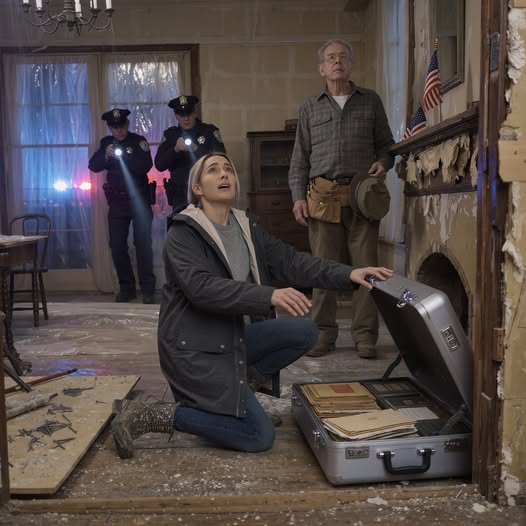
I carried the steel box to the table. When the police processed it, they documented the three compartments, but I remembered there was a second lock underneath the main compartment. A smaller combination panel built into the base.
The officers had tried a few combinations and moved on. They left it for me.
I entered the numbers.
09171974.
Lees verder door op de knop (Lees verder »») hieronder te klikken!