
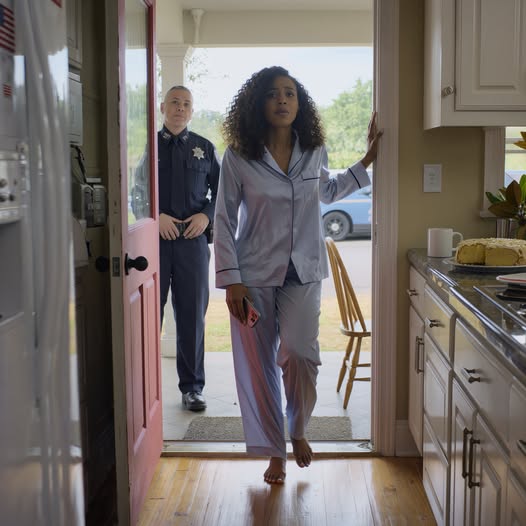
The inside had been completely renovated. The walls that used to be papered with floral prints were now smooth and white. The kitchen, where my grandmother made gumbo and sweet potato pie, had been modernized with stainless steel and marble. The bedroom where she slept was now a nursery.
But the bones of the house were the same.
The creaking floorboards near the bathroom. The uneven doorframe between the kitchen and the hall. The window in the front room that always let in too much light on summer mornings.
I stood in that front room and closed my eyes, and for just a moment I was twenty-two years old again, sitting on the floor while my grandmother hummed a hymn from the kitchen and the smell of lemon pound cake filled the air.
The memory was so vivid it almost hurt.
Sylvie let me stay as long as I needed. Before I left, she told me something that made me stop in my tracks.
“When we bought this house, the seller’s agent mentioned that the previous owner was a woman named Odessa, who had lived here for over forty years. She said the neighbors all loved her. They still talk about her.”
“She was easy to love,” I said.
I drove back to Baton Rouge with a peace I had not felt since before the dinner in May.
The house was gone, but the memory was mine.
No one could steal that.
In late October, the district attorney’s office reached a plea agreement with my mother. Given her age, her lack of prior criminal history, and my communicated preference for leniency, the felony charges were reduced. She pleaded guilty to one count of fraud and one count of forgery. She was sentenced to three years of probation, two hundred hours of community service, and was ordered to cooperate fully with the restitution process.
She would not go to prison.
But she would carry the conviction for the rest of her life.
I was not at the sentencing. I chose not to be. Claudet attended on my behalf and called me afterward.
“Your mother cried in the courtroom,” she said. “She told the judge she was sorry. She said she never meant to hurt you.”
“Did she look like she meant it?”
Claudet paused. “I think she is sorry she got caught. Whether she is sorry for what she did is a different question.”
That was honest enough.
On November 1, I received the first payment from the restitution order. It was a direct deposit of $145,000 from the sale of the duplex on Plank Road. I stared at the number on my bank statement for a full minute. Then I transferred $30,000 of it into a new savings account I had opened specifically for a project I had been dreaming about for years.
The project was simple.
I wanted to buy a house in Tremé and turn it into a community space, a small gathering place where people could come for free meals, book readings, and conversation. A place that felt like my grandmother’s porch—open and warm and welcoming to anyone who needed to sit and be heard.
I wanted to name it Odessa’s Porch.
It was not a fully formed plan yet. It was a seed.
But seeds are how everything begins.
In mid-November, exactly five years after my grandmother’s passing, I drove to the cemetery in Opelousas where she was buried. It was a small rural cemetery surrounded by sugarcane fields and live oak trees. Her headstone was modest gray granite with her name, dates, and a single line that read: She gave what she had.
I placed a bundle of fresh lavender on the grave and sat in the grass beside it. The sun was low and golden, and the air smelled like earth and sugarcane and something old and sweet that I could not name but recognized in my bones.
“I found it, Grandma,” I whispered. “I found the will. I found your note. And I fought for it. I fought for everything you left me. Not because of the money, but because you chose me. And I was not going to let anyone take that away.”
I sat there until the sun went down.
Then I drove home, and for the first time in five years, I slept without dreaming.
December came quickly. The holidays were approaching, and for the first time in my adult life, I made no plans to spend them with my family.
I did not feel sad about this.
I felt deliberate.
I had spent thirty-seven years sitting at a table where I was not valued.
This year, I would set my own table.
On December 14, I hosted a dinner at my house. I invited Naen, Corin, Margarite, and their families. Margarite brought a chocolate cake from her bakery. Naen brought her famous jambalaya. Corin brought wine and a story about a terrible date she had been on the week before that had the entire table crying with laughter.
We ate. We laughed. We told stories. We sat on my porch with blankets and watched the stars come out over Baton Rouge.
It was simple and warm and full of the kind of love that does not come with conditions.
That night, after everyone left, I washed the dishes and looked out my kitchen window at the quiet street. I thought about the dinner in May, the one where my family told me I had no purpose. And then I thought about this dinner, the one where I had filled my house with people who saw me, who valued me, who loved me as I was.
The contrast was everything.
I dried my hands, turned off the lights, and went to bed with a full heart.
January of 2025 arrived with a cold snap that covered Baton Rouge in a thin layer of frost. It was unusual for Louisiana, and the whole city seemed to move slower, bundled in coats it rarely wore. I stood at my kitchen window on the morning of January 2 and watched the frost melt from the grass as the sun came up.
There was something symbolic about it. A frozen surface giving way to warmth, revealing what was underneath all along.
The restitution payments continued to come in. By mid-January, I had recovered a total of $215,000. The remainder was being collected through the garnishment of my mother’s Social Security check, a process that Claudet said would take several years to complete.
I did not rush it.
The money was owed to me, and it would come in its own time.
I had learned patience in ways I never expected.
The project I had been dreaming about—Odessa’s Porch—began to take real shape. I found a property in Tremé, a former corner store on Ursulines Avenue that had been vacant for two years. It was small, only about 1,100 square feet, but it had high ceilings, good natural light, and a wide front porch with enough room for four rocking chairs.
The asking price was $150,000.
I made an offer of $125,000, and it was accepted.
The purchase went through on February 10.
I stood on that porch with the keys in my hand and cried for the third time in this story.
But these were the best tears, the kind that come when something you have imagined in the quiet corners of your mind suddenly becomes real and solid in yours.
I hired a local contractor named Gerard to do the renovations. He was a stocky man in his fifties with kind eyes and a work ethic that started at dawn and did not stop until the light was gone. We planned to open the front room as a community gathering space, convert the back room into a small kitchen for meal prep, and install a library wall along the west side where people could borrow books on the honor system.
Lees verder door op de knop (Lees verder »») hieronder te klikken!