
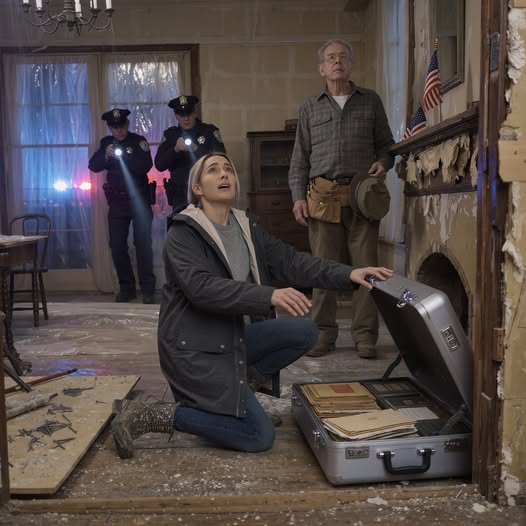
The next morning, a detective from the Ridgefield Police Department called. His name was Sergeant Ortiz. His voice was flat, professional, and careful.
“Ms. Harrow, we opened the third envelope with a forensic tech present. I need you to come in.”
I was at the station by ten.
Ortiz walked me through what they found.
Bank statements. Dozens of them. Printed, highlighted, annotated in my grandmother’s handwriting.
They traced transfers from her trust account to a personal account under Richard Harrow’s name, spread over twenty-three months. The total was approximately three hundred forty thousand dollars.
Each transfer had an authorization form attached. Each form bore my grandmother’s signature.
“Except,” Ortiz said, turning one of the pages toward me, “your grandmother wrote notes in the margins.”
He pointed to the pencil marks, small and steady.
“I did not sign this. This is not my handwriting.”
She had requested duplicate statements from the bank mailed to a private P.O. box. She had tracked every transfer she believed was improper. She had built the file herself.
“There’s also this.”
Ortiz slid another document across the table.
A request to change the trustee and legal representative of her estate, filed six months before her death. The signature was Margaret’s name, but the handwriting was wrong. Even I could see it.
“We’ve forwarded everything to the district attorney’s office,” Ortiz said. “This goes beyond a civil dispute, ma’am.”
I sat in the parking lot afterward and called the one person my coworker said could handle something like this.
Eleanor Voss, estate litigation attorney, a woman I was told had never lost a probate fraud case in twelve years.
She answered on the first ring.
I talked for nine minutes straight. She listened without interrupting.
When I finished, she said, “Your grandmother didn’t just leave you a house. She left you a case. Come to my office tomorrow. Bring everything.”
I drove home with the windows down. Even though it was cold, the air felt different. Not lighter. Clearer.
The police mentioned one more thing before I left. The third envelope also contained what Ortiz called additional documents related to family history. They had referred those to a federal agency for review.
I asked which agency.
“The FBI,” he said.
I did not ask why. I was not sure I was ready for that answer.
Word travels fast in a small town. Someone saw the police cruisers parked in front of 14 Birch Hollow. Someone told someone, and someone told Richard.
He called the next evening. No greeting. No warm-up.
“Whatever you think you found in that house, it means nothing.”
His voice was tight, controlled, but underneath it was something I had never heard before.
Fear.
“I have the best lawyers in this county. You’ll lose everything, including that shack.”
I said nothing.
He hung up.
An hour later, it was Vivien’s turn. She called sobbing. The performance was pitch perfect. Cracked voice. Shuddering breath. Carefully timed pauses before each sentence.
“Elise, you’re destroying this family. Grandma would be heartbroken. Whatever you think you have, just give it back. We can fix this. We’re your parents.”
I let her finish.
Then I said, “Good night, Mom,” and ended the call.
Celeste sent a text at midnight.
You’re delusional. Dad’s lawyer will bury you.
Two days later, the formal response arrived.
Gordon Blake walked into Eleanor Voss’s office carrying a settlement proposal. His hands were steady, but his eyes were not.
“My client is offering a generous resolution,” he said. “Elise keeps the Ridgefield property. She receives an additional fifty thousand dollars. In exchange, she signs a non-disclosure agreement and surrenders all materials recovered from the property.”
Eleanor did not blink.
“My client doesn’t negotiate when forged documents are on the table.”
Blake stood and buttoned his jacket.
At the door, he paused and said, not to me but to Eleanor, “Between you and me, tell her to be careful. Richard Harrow knows people in this county.”
The door closed behind him.
I turned to Eleanor.
“What did he mean, knows people?”
Eleanor set down her pen and folded her hands. Her expression did not shift, but something behind her eyes hardened.
“It means we might not get a fair trial here.”
I thought about my grandmother alone in her house, writing notes in the margins of bank statements no one was supposed to see.
She knew. She knew the system might not protect her.
And still, she prepared.
“Then we go somewhere that will be fair,” I said.
Lees verder door op de knop (Lees verder »») hieronder te klikken!