
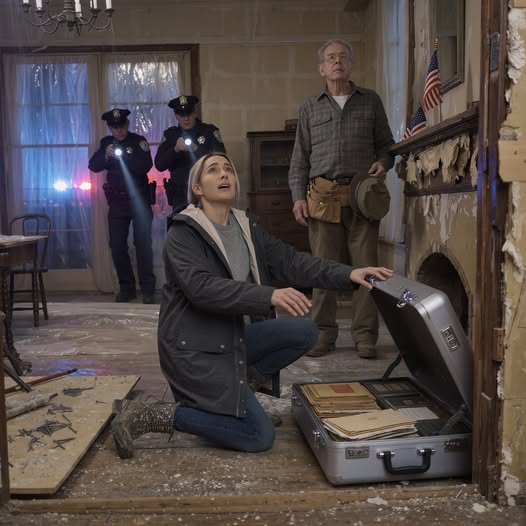
He told me the FBI was opening a federal investigation. Richard and Vivien would be subpoenaed. The documents and bank records would be analyzed by federal forensics.
“This will go to court,” he said. “And it won’t be Judge Kern’s court.”
We stood to leave. He reached out and took my hand, both of his around mine. He held it a moment longer than a stranger would.
His palms were warm. His grip was careful.
He looked at me with an expression I could not name.
“You have her eyes,” he said.
I smiled, confused.
“People say I look like my mother.”
“No,” Marcus said. “You look like Margaret.”
He let go and walked to his car.
I stood on the sidewalk watching him leave, and something tugged at the back of my mind.
A name I should recognize.
Whitfield.
Marcus Whitfield.
My grandmother’s maiden name, before she married, was Whitfield.
I stood there for a long time after his car disappeared.
Richard did not wait for the subpoena. He went on offense.
A story appeared in the Fairfield County Register, the kind of article that reads like journalism but smells like a press release.
The headline was, “Local Family in Turmoil as Youngest Daughter Contests Mother’s Estate.”
Richard was quoted as saying, “Elise is going through a difficult period after losing her grandmother. We only want to help her.”
He sounded reasonable. Caring, even. That was what made it dangerous.
Vivien took it to social media. A public Facebook post. A family photo from Christmas two years earlier. All four of us in matching sweaters. Grandma Margaret in the center.
The caption read, “Our family is being torn apart by greed and false accusations. All I ever wanted was to keep us together. Please pray for us.”
Forty-seven shares. More than a hundred sympathetic comments.
I was not tagged. I was not mentioned. But everyone knew.
At work, my supervisor pulled me aside.
“Elise, I support you. But a few donors have asked questions. Try to keep this private.”
She meant well, but there was no private. Richard had made sure of that.
Then came the real strike.
Celeste called, voice flat.
“Dad says if you don’t drop this by Friday, he’ll petition to have you declared mentally unfit.”
I thought she was bluffing. She was not.
Three days later, Eleanor forwarded me the filing: a petition for mental competency evaluation submitted to the Fairfield Probate Court.
The petitioner was not Richard. It was Vivien.
Her statement read, “My daughter has a documented history of anxiety and depression. She has made erratic decisions following her grandmother’s death. I am concerned for her safety and her ability to manage legal and financial matters.”
I did go to therapy two years earlier, for grief, for the weight of being invisible in my own family. Vivien knew because I told her, hoping she would understand.
She saved it. Not to help me. To use it.
Eleanor called within the hour.
“They’re trying to strip your legal standing. If they succeed, you can’t sue. You can’t testify. You become a ward, not a plaintiff.”
Her voice was tight.
“We need to move fast.”
I stared at Vivien’s signature on the petition. Neat. Centered. No hesitation in the strokes.
My own mother had filed paperwork to make me look unstable in order to protect what she and my father had done.
I called Dr. Patterson that same afternoon. She had been my therapist on and off for two years, the person who helped me name the patterns I grew up in. Control. Dismissal. Conditional love.
She listened to everything.
Then she said, “I’ll have the evaluation letter on your attorney’s desk by morning.”
The letter was three pages. Clinical. Thorough. Unambiguous.
“Elise Harrow demonstrates full cognitive and emotional competence. There is no clinical basis for a competency challenge. Her decision-making is consistent, informed, and self-directed.”
Eleanor filed the rebuttal within forty-eight hours, attaching Dr. Patterson’s evaluation and a motion to dismiss Vivien’s petition.
She simultaneously filed a request to transfer jurisdiction to the U.S. District Court for the District of Connecticut.
The FBI backed the transfer with a supporting brief. The Fairfield Probate Court did not fight it.
Judge Kern recused himself before he could be forced out.
The case moved up.
That evening, I did something I had never done before. I called Richard directly, not to plead, not to argue, but to inform.
“Dad,” I said, my voice level and quiet. “I know what you and Mom did. I have the original will. I have the bank records. I have the forged signatures. The FBI is involved now.”
I paused. Not for drama. For breath.
“You can stop, or this goes public. Your choice.”
Silence. Ten seconds. Fifteen.
“You’re going to regret this, Elise. You have no idea what you’re starting.”
“I didn’t start this,” I said. “Grandma did. She knew you’d come for her money. She just made sure I’d have the proof.”
I hung up.
My hands were trembling, but not the way they used to. This was not fear. This was the vibration of something finally shifting into place.
Eleanor called that night with one more piece.
FBI forensics had completed their analysis of Blake’s will. The handwriting expert’s conclusion: 99.7 percent probability that the signature on Blake’s document was not written by Margaret Whitfield Harrow.
Ninety-nine point seven.
Lees verder door op de knop (Lees verder »») hieronder te klikken!