
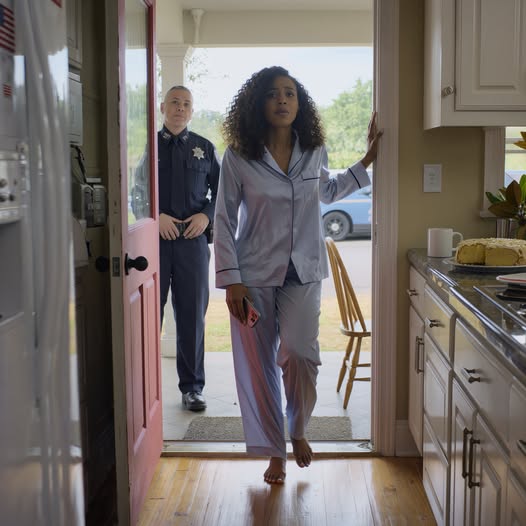
Something flickered behind her eyes. A flash of something I had never seen before.
It was not guilt.
It was fear.
Just for a second, and then it was gone, buried beneath the same mask of righteous indignation she had worn my entire life.
“What does that mean?” she asked.
“It means I think you should go home, Mom.”
She stared at me for a long moment. Then she turned, walked back to her car, and drove away without another word.
I watched her taillights disappear around the corner. Then I went inside and locked the door.
That night, I sat at my kitchen table with my grandmother’s note in front of me. I read it again slowly, letting each word settle into my bones.
You are the one who came. You are the one who sat with me. You are the one who listened.
Those words were not just a gift. They were evidence. Evidence that I had mattered. Evidence that someone in my family had seen me, had valued me, had loved me not for what I could do for them, but for who I was.
I placed the note in a fireproof lockbox I kept in my bedroom closet, along with the copies of the will and the legal documents from Claudet.
Then I went to bed.
The following Monday, May 27, Claudet called me with an update. She had filed the petition to reopen the succession in Orleans Parish Civil District Court. She had also submitted a formal complaint to the East Baton Rouge District Attorney’s Office, accompanied by copies of the original will, the fraudulent will, and the parish records showing the discrepancy.
She told me that the process would take time, possibly several months, but that the evidence was overwhelming and she was confident in the outcome.
“There is one more thing,” she said. “I did some additional research on the property sale. The house on Daffine Street was sold to a developer for $210,000. However, comparable properties on that street have since been appraised at values between $300,000 and $310,000. The house may have been sold under market value, which could indicate additional irregularities in the transaction.”
I closed my eyes.
Every new piece of information was another layer of betrayal, another revelation that my mother had not just stolen from me. She had done it carelessly, cheaply, as if what my grandmother left behind was not even worth the effort of doing it right.
“Thank you, Claudet,” I said. “Keep me updated on everything.”
“I will, Martha. And I want you to know something. Your grandmother was a remarkable woman. I only met her once, the day she signed that will. But she spoke about you with so much love. She wanted you to be protected. That is why she came to me.”
I hung up and sat in the silence of my house.
And for the second time that month, I cried.
But these tears were different. They were not tears of grief or humiliation. They were tears of something I had not felt in a very long time.
They were tears of being believed.
The next few weeks moved slowly, like a river carrying something heavy beneath its surface.
I went to work every day. I tended my garden. I met with my book club. I lived my life with a deliberate, measured calm that surprised even me.
On the outside, nothing had changed.
But on the inside, I was preparing.
Claudet kept me informed through weekly phone calls and occasional emails. The court had accepted the petition to reopen the succession. A hearing date was set for August 14. The district attorney’s office had opened a preliminary investigation.
The wheels of justice were turning slowly but unmistakably.
In the meantime, my family continued to behave as though nothing had changed, because in their minds, nothing had.
My mother called every few days, leaving voicemails that alternated between guilt and anger.
“Martha, I do not understand why you are being so difficult.”
“Martha, Colette needs support right now. This is not about you.”
“Martha, your father has high blood pressure. This stress is not good for him.”
Each message was a variation on the same theme: that I was the problem. That my silence was a wound I was inflicting on them. That the only path to family harmony was my compliance.
I did not respond to any of them.
Colette sent me a series of texts during the first week of June that ranged from dismissive to hostile.
You are really going to throw a tantrum over being asked to help.
You are almost forty years old with no husband and no children and you cannot even help your own sister.
Mom says you are going through something. Whatever it is, get over it.
The last one was a photo of her sonogram with the caption: This baby deserves an aunt who shows up.
I saved every message. Every voicemail. Every text.
Claudet had told me to document everything, and I did.
In the middle of June, something unexpected happened.
My father called me.
Not my mother using his phone. Not a group call. Just him. Renard Pierre calling his eldest daughter, which he had not done in over a year.
“Martha,” he said. His voice was gruff, the way it always was. But there was something underneath it, something tired. “Your mama is real upset. She wants you to come to Sunday dinner.”
“I am not coming to Sunday dinner.”
“Martha, this family—”
“This family volunteered me as a babysitter and told me I have no purpose. I do not owe anyone dinner after that.”
There was a long silence. Then he said something that stopped me cold.
“Your grandmother would not have wanted this.”
I gripped the phone so hard my knuckles turned white.
“Do not talk to me about what my grandmother would have wanted. You do not know the first thing about what she wanted.”
He hung up.
And I stood there in my kitchen shaking with a fury I did not know I was still capable of feeling.
That was the moment I realized the hardest part of this was not the legal battle. It was the emotional one.
Because even though I knew what my mother had done, even though I had the documents and the evidence and the truth, there was still a part of me, a small and stubborn part, that wanted to be wrong. That wanted there to be an explanation. That wanted my mother to be the person I had always wished she was instead of the person she had always been.
But wishing does not change facts.
And the facts were clear.
At the end of June, Claudet called with a new development. The district attorney’s office had subpoenaed bank records from the joint account held by my mother and Colette. The records showed that the $390,000 had been deposited in installments between February and May of 2020. Of that amount, approximately $260,000 had been withdrawn by my mother over the following two years. Roughly $95,000 had been transferred to an account in the name of Colette Pierre Landry. And the remaining $35,000 had been used to pay off a car loan in the name of Renard Pierre.
Every member of my family had benefited from the theft.
Every single one.
Lees verder door op de knop (Lees verder »») hieronder te klikken!